
Your needs, this model
Does it fit your priorities?
Can one machine handle both bound originals and a paper batch?
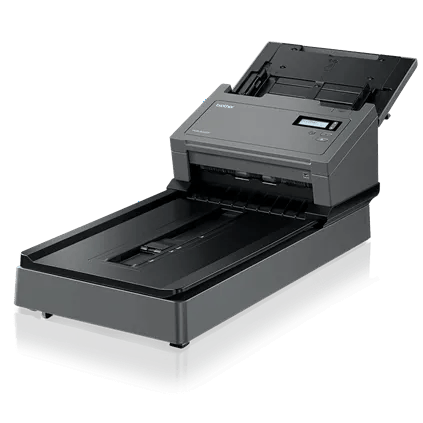
Yes, in two different routes: Brother documents a legal-size flatbed for single bound, delicate or irregular originals and a one-pass duplex ADF rated for up to 100 sheets of 28–80 g/m² paper. The 100-sheet maximum is stock-dependent; the questionnaire does not itself ask whether a flatbed is essential.
Explore this need in the finder →Does the 6,000-page daily rating mean a recommended everyday workload?
No. Brother labels 6,000 pages per day as a maximum via the ADF and says the rating compares designed durability among similar models; it recommends choosing a rating above the intended requirement. It is not a test of uninterrupted operation or a daily workload recommendation.
Explore this need in the finder →Can the PDS-5000F duplex a 236-inch long original?
No. Brother's 236-inch limit is for one ADF-fed sheet scanned one-sided at 200 dpi. The model-qualified specifications cap a two-sided original at 14 inches; do not treat the long simplex limit as duplex support.
Explore this need in the finder →Assessment: The Brother PDS-5000F combines a 100-sheet, one-pass duplex ADF with a legal-size flatbed, so it covers two rather different originals-handling jobs in one earlier-model desktop unit. That versatility is more meaningful than its headline speed: the feeder is stock-dependent, long-paper support is simplex-only at the stated maximum, and Brother marks the model discontinued. This is a source-based assessment, not a hands-on test or a claim about any current seller's unit.
Identify the F model, not a nearby PDS
Brother's U.S. page identifies the model code as PDS5000F and describes an integrated flatbed. The “F” matters. The earlier PDS-5000 review covers a sheet-fed scanner without that glass, while the PDS-6000 is a faster ADF-only model. Do not treat those three model names or their specifications as interchangeable.
Brother marks the PDS-5000F discontinued. Its product page lists a scanner, AC adapter with U.S. and Brazil cords, USB 3.0 cable, setup guide, installation DVD and a warranty sheet as original carton contents. That is not an inventory of a used or reseller package, nor does it establish an individual unit's condition, remaining roller life, warranty transfer or availability. Ask for the exact model label and actual package before ordering.
The flatbed and feeder do different work
The glass is the reason to choose the PDS-5000F over a feeder-only scanner when you need to capture a bound page, a delicate original, or a single irregular sheet without sending it through the rollers. Brother gives the flatbed a maximum 8.5-by-14-inch area; its brochure lists a one-inch minimum in either dimension. Larger books or oversize originals still need another capture method.
Loose pages belong in the ADF. Brother rates it for up to 100 sheets of 28–80 g/m² paper, but the model's User's Guide lowers the maximum to 70 sheets at 105 g/m², 60 at 127 g/m², 50 at 200 g/m² and 15 at 400 g/m². Business cards have a separate 15-card maximum. Those are loading limits for named stock, not a general promise about mixed batches or daily throughput. The PDS-5000F guide also differs from the non-F PDS-5000 guide at 105 g/m², so check the correct manual rather than borrowing a sibling's capacity table.
The ADF handles duplex in one pass. The flatbed is a single-original route; its presence does not convert a long feeder document into a duplex flatbed job. For fragile, curled or otherwise difficult pages, use Brother's specific handling instructions and carrier-sheet procedure where applicable. Its A4 carrier sheet for ADF plastic-card scanning is separately purchased, and the manual limits ADF plastic-card handling to one card at a time. A carrier sheet is not a separate manual-feed inlet.
Read the speed and duty figures with their conditions
Brother's headline rate is up to 60 pages per minute, or 120 images per minute for two-sided capture, at Letter size and 300 dpi with advanced features off. Its model-qualified specification reduces the listed maximum to 15 ppm and 30 ipm at 600 dpi. These are manufacturer ratings, not measured results; computer performance, scan settings, multi-feed checks and image processing can change the elapsed time for a real batch.
The 236-inch (5,994 mm) maximum applies to one ADF-fed sheet scanned one-sided at 200 dpi. Brother limits two-sided document length to 14 inches (356 mm). A long form can therefore fit the stated simplex path without qualifying for the same length in duplex. The 6,000-page daily figure is also an ADF maximum: Brother presents it as a durability comparison between similar models and recommends a rating above the intended requirement. It is not a tested or recommended everyday workload.
USB and old software shape the routine
This scanner connects to a computer over SuperSpeed USB 3.0; Brother specifies USB 2.0 compatibility as well. The brochure says network connectivity is absent. Brother lists TWAIN, WIA, ICA, ISIS and SANE driver standards and describes DS Capture and Button Manager V2. Destinations such as email, FTP, network folders and SharePoint are routed through the host software; they do not make this a Wi-Fi, mobile-device or computer-free cloud scanner.
Brother's supported-OS page names Windows through 10 and macOS versions through 14.x, and cautions that software for gray-listed operating systems is no longer updated. That list does not establish compatibility with a particular newer computer, application or driver installation. Before buying, check the current PDS-5000F download page against the exact host and capture workflow, and confirm the USB port and cable arrangement.
Who should keep it on a shortlist?
The PDS-5000F is most interesting when a desktop workflow genuinely needs both a flatbed for stationary originals and an ADF for loose two-sided pages. It is less compelling if the desk only handles ordinary paper stacks: the flatbed adds a larger base, while the sheet-fed PDS-5000 has a smaller footprint and the PDS-6000 is rated faster. The PDS-6000's speed advantage does not include a flatbed, and none of these PDS models documents a wireless or direct-cloud route.
Because this model is discontinued, inspect the exact label and the actual scanner rather than relying on an old listing title. Check the seller's return terms, condition, accessory list and any stated warranty; ask about feed history and maintenance, and verify the host software before purchase. The sources do not establish an individual used unit's performance or condition. For the practical limits of feeder loading and duplex handling, see the feeder and duplex guide; the connection guide explains why computer-routed destinations are not scanner networking.
Key specifications
Key details at a glance
| Scanner class | Professional desktop flatbed adf hybrid |
|---|---|
| Manufacturer-listed simplex rate | 60 ppm |
| Manufacturer-listed duplex image rate | 120 ipm |
| Automatic document feeder capacity | 100 sheets |
| Optical resolution | 600 dpi |
| Connection options | USB |
| Automatic duplex capture | Yes |
| Separate manual-feed route | No |
| Touchscreen | No |
| TWAIN driver documented | Yes |
Use the exact model’s instructions for operating limits, supplied equipment and version differences.
Sources for this review
Sources for this assessment
- Brother PDS-5000F U.S. product page, identity, status, features and carton description
- Brother PDS-5000F U.S. support and downloads route
- Brother PDS-5000F specification table
- Brother PDS-5000F U.S. manuals index, User's Guide version E and Setup Guide
- Brother User's Guide for PDS-5000F/PDS-6000F, version E
- Brother U.S. Quick Setup Guide for PDS-5000F, version A
- Brother PDS-5000F Professional Document Scanner brochure
- Brother PDS-5000F supported operating systems page
- Brother PDS-5000F official product-page image asset
- Brother U.S. recall notice page, screened for PDS-5000F
Compare the workflow before you choose
Use the finder to test your connection, paper and software requirements against the documented scanner arrangements.