
Your needs, this model
Does it fit your priorities?
Can the DS-320 duplex-scan a 20-sheet stack?
Yes, on the guide's Letter-paper 21 lb (80 g/m²) basis: the DS-320 is rated for 20 ADF sheets and duplex capture. The load is 25 sheets at 64 g/m² and 12 at 128 g/m², so match the actual stock to the manual.
Explore this need in the finder →Does the DS-320 have a separate route for a plastic ID card?
Yes, but narrowly: the manual describes a separate card slot for one vertical ISO 7810 ID-1 plastic card no thicker than 1.0 mm; plastic cards must not be loaded through the ADF, and glossy, laminated or embossed cards may not work well. It is not a generic alternate feeder for any fragile original.
Explore this need in the finder →Can I scan to a phone or cloud service without a computer?
No such route is documented for this USB-only model. The reviewed plan is computer-connected USB; USB bus power requires a USB 3.0 host port, and Epson's 25/50 rating is based on AC-adapter use.
Explore this need in the finder →What should I verify before connecting the DS-320 to my software?
Epson lists TWAIN and ISIS and its support page currently offers a Windows 11 download view, but that page displays a -N model string and the old guide lists older OS requirements. Confirm the exact host, driver, named application and support status before purchase or deployment.
Explore this need in the finder →A portable scanner with a real stack feeder
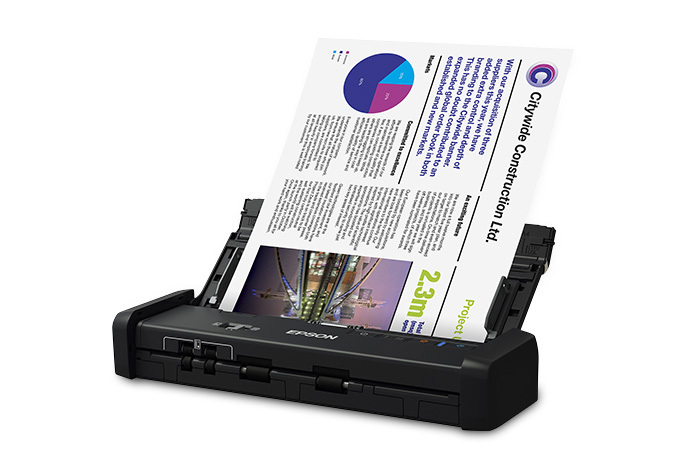
The Epson DS-320 is a discontinued U.S. portable duplex scanner with an automatic document feeder, not a one-sheet travel wand. Epson's exact product page identifies base model B11B243201, marks it discontinued, and names the DS-C330 as the replacement. Its separate 20-page ADF and single-pass duplex path make it a different proposition from Epson's older single-sheet DS-70 and wireless DS-80W. That distinction can matter to an earlier-model shortlist, but it does not establish that a new, complete DS-320 is currently available.
The capacity needs a paper-weight qualifier. Epson's guide specifies 20 Letter sheets at 21 lb (80 g/m²), 25 sheets at 17 lb (64 g/m²), and 12 at 34 lb (128 g/m²); it also warns that capacity can vary by paper type. So “20-sheet ADF” is a useful standard-paper threshold, not a promise that every stack of 20 will feed. A minimum of 30 sheets exceeds the documented 80 g/m² loading count. The separate plastic-card slot is not a second paper feeder and cannot be added to the ADF count.
The manufacturer comparison sheet lists the DS-320 beside the DS-70 and DS-80W as a portable-or-desktop model, with 25 ppm/50 ipm, 600 dpi and USB 3.0. Those are specifications from Epson, not independent tests. The sheet helped surface this model, but neither it nor the current category page gives a complete scanner count or pagination result.
USB, drivers and power are one host-centered workflow
The reviewed DS-320 arrangement is USB-to-computer. Epson lists TWAIN and ISIS driver support, but the existence of a driver does not prove that a particular records system, image-capture app, operating-system revision or managed workstation will work. Confirm the exact software's requirements and the current downloads before choosing it for a production workflow. The official support page currently exposes a Windows 11 download view, but its product-home model field displays B11B243201-N while the exact product page identifies B11B243201. I preserve that support-route mismatch rather than treating the suffix as proof of a separate scanner or renewed package.
There is no documented Wi-Fi, phone/tablet scanning or scanner-side cloud destination in this reviewed configuration. If a mobile or computer-free workflow is essential, this is not the right profile. USB bus power is available, but Epson's guide says to use a USB 3.0 host port for bus-powered operation and warns against USB 2.0/1.1 bus power. The published 25 ppm/50 ipm maximum is tied to AC-adapter use; do not carry that rating over to bus power or interpret it as measured end-to-end office speed.
The guide allows originals up to 44 inches only when scanning at 300 dpi or lower. Such long originals have their own software and setup conditions. That limit is not interchangeable with ordinary Letter/A4 loading guidance, and it does not establish that every business system accepts the resulting page size.
The separate card slot is useful but narrowly defined
The physical mode selector distinguishes the ADF from a dedicated card slot. Epson's manual describes the card path for one vertical ISO 7810 ID-1 plastic card, up to 1.0 mm thick. It explicitly says not to load plastic cards into the ADF. The manual also cautions that glossy, laminated or embossed cards may not scan properly. That evidence supports a limited card-handling route; it does not justify treating the DS-320 as a passport, book, fragile-paper or general special-original scanner.
This matters to the finder's “manual feed” choice. Here, that tag means only that the scanner has a separate, selectable card route alongside the ordinary ADF. It is not an alternate feeder for a batch of different stock, does not add a card to the 20-sheet stack, and does not guarantee success for every ID card. Check a target card's material, thickness and condition against the manual before relying on this path.
Age, duty guidance and service evidence
Epson lists a daily guidance figure of up to 500 sheets, a 600 dpi optical resolution and a body measuring about 11.3 by 3.5 by 2 inches at 2.4 lb. The daily figure is separate from the one-load ADF limit and is not an endurance test. No independent jam-rate, accuracy, OCR, durability or throughput testing was performed for this assessment. Treat the dimensions as published specifications, not measurements taken here.
Warranty information is not consistent across the official records reviewed: the current exact product page displays a three-year limited-warranty statement, while Epson's January 2017 launch release said one year. Neither statement resolves what coverage, if any, applies to an old-stock, used or third-party-sold unit today. Ask for the written unit-specific warranty and service terms; do not assume coverage transfers or that an optional plan remains obtainable.
What to compare before choosing an older DS-320
The single-sheet DS-70 is a simpler comparison if occasional simplex pages matter more than a stack, while the DS-80W adds a wireless/battery profile but still does not turn into a 20-sheet ADF. The DS-C330 is Epson's named replacement and should be assessed on its own exact features, package and support—not assumed to inherit DS-320 behavior. The DS-320's unusual middle ground is a compact, wired duplex scanner with a small but genuine ADF and a separate one-card slot.
Before buying any offered DS-320, match the B11B243201 identity, inspect the actual condition and package, and confirm that the USB cable, power equipment and expected card route are present and usable. Check driver support against the exact computer and software, then obtain written return and warranty terms from the seller. The manufacturer page's discontinued label is a lifecycle fact, not a stock claim. If wireless/mobile operation, a larger paper load, an assured modern support path or a transferable service plan is required, compare current documented alternatives rather than treating an old product listing as proof.
The DS-320 is worth considering only when its dated design matches the workflow: USB to a host computer, automatic duplex, a 20-sheet load on the 80 g/m² basis, and occasional use of the narrowly specified card slot. Its official product page, user guide and support downloads are the right places to re-check model-specific details. None substitutes for inspection of the exact scanner and terms being offered.
Key specifications
Key details at a glance
| Scanner class | Portable duplex scanner with ADF |
|---|---|
| Manufacturer-listed simplex rate | 25 ppm |
| Manufacturer-listed duplex image rate | 50 ipm |
| Automatic document feeder capacity | 20 sheets |
| Optical resolution | 600 dpi |
| Connection options | USB |
| Automatic duplex capture | Yes |
| Separate manual-feed route | Yes |
| Touchscreen | No |
| TWAIN driver documented | Yes |
Use the exact model’s instructions for operating limits, supplied equipment and version differences.
Sources for this review
Sources for this assessment
Compare the workflow before you choose
Use the finder to test your connection, paper and software requirements against the documented scanner arrangements.