
Your needs, this model
Does it fit your priorities?
Does the DS-70000 offer a TWAIN USB computer route?
Epson lists USB 2.0 and TWAIN/ISIS drivers. Check the current host OS and exact application.
Explore this need in the finder →Does its ADF duplex 200 sheets at once?
Epson lists one-pass duplex and a 200-sheet ADF at approximately 20 lb (80 g/m²). Other paper limits remain relevant.
Explore this need in the finder →Does the large flatbed provide manual feed?
No. Glass placement is a separate platen task and no manual-feed mode for the ADF is documented.
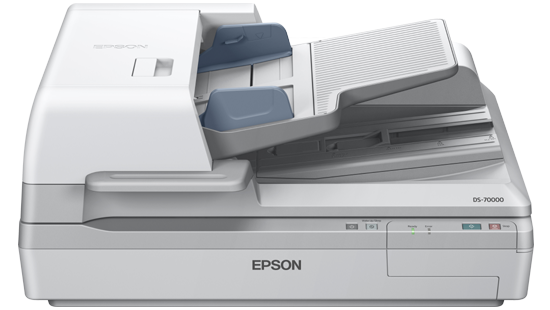
Explore this need in the finder →The Epson WorkForce DS-70000 is the faster hybrid sibling in Epson's large-format DS-60000/DS-70000 family. Part B11B204321 combines an 11.7-by-17-inch flatbed with a 200-sheet duplex ADF rated to handle originals as long as 100 inches. It is designed for departmental paper operations where larger books, drawings, maps, or other awkward pages share a station with batches of loose originals—not for a small desktop or a phone-first home workflow.
Faster ADF work, still distinct from the platen
Epson publishes up to 70 ppm/140 ipm for ADF scanning at 200 dpi and 50/100 at 300 dpi; the rate drops at 600 dpi. These numbers are manufacturer figures, not independent measurements and do not include file review, OCR, or document management. The 200-sheet feeder figure is specified around 20 lb (80 g/m²) paper, with size and thickness limits in the model guide. The platen is a separate 11.7-by-17-inch surface for bound and irregular items. It does not inherit the ADF's batch capacity or duplex cycle: a page placed on glass requires human positioning and separate capture steps.
USB base, optional network module
The base scanner lists Hi-Speed USB 2.0 and TWAIN/ISIS driver support. Epson describes an optional Network Interface Unit for sharing access with networked computers. It is a separate accessory, so verify the exact part and whether it is included in the seller's configuration. Although Epson's page describes cloud and network destinations through its software, those routes depend on an attached computer and the supported Document Capture software; the source evidence does not establish a direct scanner-to-cloud or mobile workflow. The product's physical controls are not a touchscreen.
Capacity, space, and compatibility checks
This unit weighs and occupies considerably more than a desktop feeder, and the lid and output path need room to operate. Measure the intended location and account for operator access, paper loading, the flatbed cover, and the cable route before purchase. Its 100-inch ADF length and 17-inch glass width are useful only within the guide's paper weight, size, and loading rules. The exact U.S. product listing states a three-year limited warranty; get the seller's written warranty and service terms, especially if considering an older or renewed offer. Confirm the scanner's current host operating system, driver, TWAIN/ISIS application, and network adapter support with the organization's IT team.
How it differs from the DS-60000
Both models pair the same general 200-sheet ADF and 11.7-by-17-inch flatbed dimensions, so a larger feeder figure is not the differentiator. The DS-70000's stated duplex speed is 70/140 at 200 dpi compared with the DS-60000's 40/80; at 300 dpi the published rates are 50/100 versus the lower DS-60000 rating. Both remain wired USB-first scanners with an optional network module, TWAIN/ISIS support, and host-dependent file destinations. Choose by your actual speed and original mix, not the shared family name.
A high maximum speed is most useful when routine paper, resolution, application, and receiving system all allow the feeder to operate near that mode; it says less about a mixed job that includes large, delicate, or bound originals. The platen is what makes this family materially different from a large-capacity-only ADF. Staff can choose the appropriate surface, but software workflow and physical page handling remain separate tasks. Where only loose Letter batches are expected, the larger flatbed and footprint may not earn their place; where oversize originals recur, the surface can avoid forcing them through rollers.
Assessment: the DS-70000 makes sense to investigate when higher departmental batch speed and a large-format flatbed are both necessary. Its size, accessory-dependent network sharing, and computer-owned file workflow are part of the purchase decision. It is not a touchscreen or wireless model, and its speed claims should not be read as field-test results. The assessment is based on Epson documentation; no hands-on use, measurement, or availability is claimed.
Key specifications
Key details at a glance
| Scanner class | Large format flatbed adf hybrid |
|---|---|
| Manufacturer-listed simplex rate | 70 ppm |
| Manufacturer-listed duplex image rate | 140 ipm |
| Automatic document feeder capacity | 200 sheets |
| Optical resolution | 600 dpi |
| Connection options | USB |
| Automatic duplex capture | Yes |
| Separate manual-feed route | No |
| Touchscreen | No |
| TWAIN driver documented | Yes |
Use the exact model’s instructions for operating limits, supplied equipment and version differences.
Sources for this review
Sources for this assessment
Compare the workflow before you choose
Use the finder to test your connection, paper and software requirements against the documented scanner arrangements.