
Your needs, this model
Does it fit your priorities?
Is the 100-sheet figure the same as a daily scan target?
No. Epson rates the ADF for a 100-sheet loading at 80 g/m² and separately states a 4,000-pages-per-day duty figure. Neither is a measured result; the paper-weight range, document condition and job workflow matter too.
Explore this need in the finder →Can a book or curled original use the feeder because the DS-7500 has a flatbed?
The flatbed is a separate route. Epson directs books and curled or damaged originals to the glass, while its feeder is for supported loose paper; the bed is limited to 8.5 × 11.7 inches. The glass is not a manual-feed slot and does not enlarge the ADF's stock limits.
Explore this need in the finder →Does the optional Ethernet module preserve USB or make cloud computer-free?
No on both counts. The B12B808411 module is separate; the family guide says USB is disabled while it is installed. Epson's scan-to-cloud instructions depend on a connected Windows PC running Document Capture Pro.
Explore this need in the finder →Earlier-model assessment · Epson U.S. part B11B205321
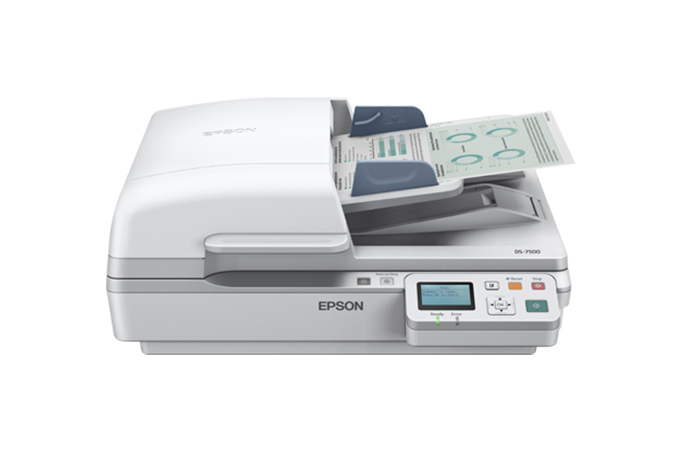
The WorkForce DS-7500 is a sizeable desk scanner built around two distinct ways of handling originals: a stack feeder for loose pages and a separate glass bed for material that should stay flat. The exact U.S. Epson page identifies part B11B205321 and explicitly labels it discontinued. This is a source-based review of an earlier reference, not a claim that a particular used or old-stock unit is available or suitable, and not a hands-on test.
A larger stack feeder, with a separate platen
Epson rates the ADF for 100 sheets of paper at 80 g/m² and describes one-pass, two-sided scanning. Its published maximum is 40 pages per minute and 80 images per minute for Letter pages at 200 or 300 dpi, in black-and-white or color. At 600 dpi, the same U.S. specification sheet lists up to 8 ppm/16 ipm instead. Those are manufacturer figures under specified settings, not a measure of the full time to prepare, inspect, name or file a real job.
The feeder accepts originals up to 8.5 by 40 inches, while the flatbed is 8.5 by 11.7 inches. That glass is useful for bound material or a supported original that should not travel through rollers, but it does not handle a long legal page by virtue of the ADF's longer path. Measure the original and the scanner's clearances before assuming it fits. The manual gives separate stock ranges—50–128 g/m² above A6 and 60–190 g/m² for A6 or smaller—and directs photos, booklets, glossy or non-paper items, staples or clips, wet ink, attached sticky notes, loose labels and damaged or folded originals to the glass. A 100-sheet tray is therefore a loading rating for specified stock, not permission to feed every special original in a batch.
Speed is only one difference from the DS-6500
The closely related DS-6500 shares the 100-sheet one-pass duplex ADF and the same stated glass size, but Epson's exact U.S. materials list 25 ppm/50 ipm for the DS-6500 and 40/80 for the DS-7500 at the relevant Letter settings. Epson also states a 4,000-page daily duty figure for the DS-7500 and 3,000 for the DS-6500. These dated manufacturer ratings distinguish the models; they are not an independent benchmark, nor do they tell you the condition or remaining life of a secondhand machine. The DS-7500's headline speed falls sharply at the listed 600-dpi setting, so compare like resolution and color mode rather than relying on a single maximum.
Connection options depend on the accessory
The base B11B205321 uses Hi-Speed USB 2.0 with a computer. Epson also identifies a Network Scan Module, part B12B808411, for wired Ethernet; it is an optional accessory, not part of the base product assumptions. The shared family guide says the USB port is disabled while this module is installed, so these are alternative operating arrangements rather than two connections you can count on using together. Neither the base product nor this Ethernet option establishes built-in Wi-Fi or phone/tablet capture.
Epson's cloud wording has a separate dependency: its U.S. page and specification sheet tie Scan to Cloud to Document Capture Pro installed on a connected Windows PC. The Ethernet module can support network scanning to a PC, but that does not make cloud transfer computer-free. The product page advertises TWAIN and ISIS drivers, which can help when a business application requires a standard capture interface. Still, check the exact B11B205321 support downloads for the intended operating system and confirm the named capture application with its vendor; an older driver listing is not a compatibility guarantee.
Desk, controls and upkeep
Epson's exact page gives a 19.4 by 14.1 by 8.5-inch body and a 22.5-pound weight. That is a settled-workstation profile, not a portable one. The shared guide instead reports about 21.6 pounds without the ADF input tray and slightly different dimensions, so those figures should not be treated as the same measurement setup. The panel is described with physical controls and indicators; one-touch programmable jobs are not evidence of a touchscreen workflow. Epson's original box list includes a USB cable, software CD, AC adapter and power cable, but a current seller may omit items or supply a different condition. The guide identifies replaceable rollers, so ask about feed path condition and service history for any used offer.
Who might still shortlist it?
Consider investigating the DS-7500 only if the combination of a 100-sheet duplex ADF and a separate letter-size-class bed solves a real two-route paper task, a wired computer workflow is acceptable, and you are prepared to verify an older system's software path and an exact unit's condition. Look elsewhere if built-in Wi-Fi, mobile capture, a touchscreen, a separate manual-feed inlet, a larger platen or assured current driver support is essential. The optional network module should not be treated as a modern wireless upgrade.
Evidence and purchase checks
This assessment uses Epson's U.S. B11B205321 product page, the DS-7500 specification sheet, the shared DS-6500/DS-7500 user guide and the exact U.S. support page, checked October 31, 2026. Before considering an offer, match part B11B205321; verify seller condition, package, return and warranty terms; ask about roller/service history; confirm the target OS and required TWAIN/ISIS application; and only count B12B808411 if that separate module is actually present. No price, ASIN, current seller, availability or customer experience is asserted here.
Key specifications
Key details at a glance
| Scanner class | Flatbed color document scanner with adf |
|---|---|
| Manufacturer-listed simplex rate | 40 ppm |
| Manufacturer-listed duplex image rate | 80 ipm |
| Automatic document feeder capacity | 100 sheets |
| Optical resolution | 1200 dpi |
| Connection options | USB / Ethernet |
| Automatic duplex capture | Yes |
| Separate manual-feed route | No |
| Touchscreen | No |
| TWAIN driver documented | Yes |
Use the exact model’s instructions for operating limits, supplied equipment and version differences.
Sources for this review
Sources for this assessment
- Epson U.S.: WorkForce DS-7500 Color Document Scanner, B11B205321
- Epson WorkForce DS-7500 Product Specifications CPD-37535
- Epson DS-6500/DS-7500 User's Guide
- Epson U.S. Support: WorkForce DS-7500 B11B205321
- Epson U.S.: WorkForce DS-6500 Color Document Scanner, B11B205221 (related-products record)
- Epson U.S.: exact DS-7500 product-gallery image
Compare the workflow before you choose
Use the finder to test your connection, paper and software requirements against the documented scanner arrangements.