
Your needs, this model
Does it fit your priorities?
Will its ADF handle a duplex stack and do I need the platen too?
Fujitsu's U.S. sheet identifies this exact PA03289-B715 model as the flatbed sibling and rates its duplex ADF up to 50 Letter/A4 sheets at 20 lb per load. The flatbed is a separate one-at-a-time path; it does not increase feeder capacity or prove a separate manual-feed bypass.
Explore this need in the finder →Does the U.S. part support my USB/TWAIN capture application today?
Historical U.S. and PFU documents list USB 2.0 and TWAIN/ISIS for older Windows releases. PFU's archived support page says systems outside its table are not compatible; that dated evidence does not establish a current build or successful install. Verify the exact host, application, cable and scanner before relying on a used unit.
Explore this need in the finder →Can it replace a Wi-Fi scanner or use phone scanning?
No wireless or mobile route is documented for this model. The exact U.S. and PFU sources identify USB and Ultra SCSI host connections, not Wi-Fi or a phone workflow. A computer-free cloud path is also not established.
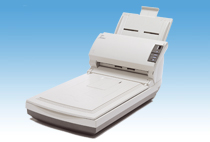
Explore this need in the finder →The Fujitsu fi-4220C2 is the flatbed-equipped member of the older fi-4120C2/fi-4220C2 U.S. workgroup pair. Fujitsu's U.S. sheet identifies this exact model as part PA03289-B715; it gives the fi-4220C2 a flatbed while the fi-4120C2 is ADF-only. PFU America lists the fi-4220C2 in its U.S. Discontinued for Service table. That is lifecycle context, not a current offer, a promise of parts or a description of what a used seller includes.
A 50-sheet duplex ADF plus a separate platen
PFU's archived model page and Fujitsu's U.S. datasheet describe two different original paths. The ADF handles paper stacks and captures both sides automatically; the flatbed handles one original at a time. The U.S. sheet specifies up to 50 Letter/A4 sheets at 20 lb per feeder loading, while PFU states 50 A4 sheets at 80 g/m². Treat that as a qualified maximum for one load, not a guarantee for heavier or mixed stock and not a daily-volume rating. The U.S. source also describes a 34-inch long-paper mode and hard-card scanning, with the important limit that embossed text is not supported.
The published feeder rate is up to 25 pages per minute simplex or 50 image sides per minute duplex at the source's stated settings: monochrome/grayscale at 200 dpi and color at 150 dpi. These are scanner specifications, not results from an independent test or a prediction for a particular computer, driver, file type or batch. The A4 flatbed figures are around 2.1–2.2 seconds per image in the archived table at its respective black-and-white/color settings. That helps distinguish platen work from feeder throughput; it does not say how long a bound book or a multi-page job will take.
The glass is useful, but it is not another feeder mode
The flatbed is the reason to choose this configuration over an ADF-only scanner when a bound page, stiff original or sheet that should not enter the rollers is part of the routine. It is a one-at-a-time platen path, not a separate ADF manual-feed bypass. The distinction matters if a workflow needs special originals to pass through a feeder one by one: the reviewed evidence does not document that route here.
The maximum platen description is not perfectly aligned across the two exact sources. Fujitsu's U.S. sheet calls it 8.5 by 11.4 inches, while the PFU Global page says A4, 210 by 297 mm. I preserve each source's wording rather than convert them into a false agreement. For a document near that boundary, check the supported area in the exact unit's manual and test the full page rather than assuming every Letter edge is captured.
USB is the simpler legacy route; SCSI adds host work
The U.S. sheet lists high-speed USB 2.0 and Ultra SCSI; PFU's archive also lists USB 2.0/1.1 and a 50-pin SCSI interface. Both are wired computer connections, not Wi-Fi, phone scanning or computer-free cloud transfer. The archive names several historical SCSI cards and warns that other cards may cause unstable operation. That makes SCSI a system choice, not just a socket to check: a buyer would need a compatible controller, cable, driver and host. Neither should be assumed to arrive with an unspecified used package.
TWAIN and ISIS appear in the old U.S. bundle and PFU model records, and PFU's archived download table identifies dated drivers for old Windows releases. Its table explicitly says unlisted operating systems are not compatible. This is useful evidence for a verified legacy workstation, but it does not certify a current Windows build, macOS/Linux, a capture application, license transfer, an available download or a successful installation. Test the exact computer and scanning program before treating the scanner as ready for work.
What the physical and maintenance figures leave open
Fujitsu's U.S. sheet gives a 17.6 lb body and dimensions of about 11.9 inches wide, 22.4 deep and 9 high. The space plan should include the ADF input chute, output stack, lid opening, cable route and the room needed to use the platen—not just the closed-body outline. PFU lists an infrared multi-feed sensor. That is a detection aid, not a no-jam guarantee. The exact archive also identifies a replaceable pad and pick roller; its suggested replacement cycle assumes 64 g/m² A4 plain paper and varies by paper condition. A model number cannot establish remaining wear life in a particular machine.
Where it sits beside similar older models
The fi-4120C2 shares the 50-sheet duplex ADF and legacy wired character but lacks the flatbed; its U.S. part is PA03289-B315. The fi-5220C also combines a duplex ADF and platen, but is a separate model with its own archival specification and no U.S. part established in this research. The fi-5015C is another ADF-plus-flatbed model, but its listed ADF is simplex rather than duplex. These names are close enough that a seller title or family photograph should not substitute for checking the machine label and actual glass platen.
Assessment and checks before considering a unit
This model is a plausible research-based fit for someone who specifically wants duplex paper stacks plus a platen and can verify a legacy USB or SCSI software setup. It is a poor fit when wireless, mobile capture, touchscreen profiles, guaranteed modern driver support or a separate ADF manual-feed route is essential. Before buying any particular unit, confirm the label says fi-4220C2/PA03289-B715, verify that its ADF and platen work, identify the enabled interface, test a duplex scan on the intended host and application, inspect rollers and glass, and confirm power equipment, cables, software media, return terms and package contents. The historical brochure's inbox table is not proof that those items accompany a present seller offer.
Key specifications
Key details at a glance
| Scanner class | Flatbed document scanner with duplex ADF |
|---|---|
| Manufacturer-listed simplex rate | 25 ppm |
| Manufacturer-listed duplex image rate | 50 ipm |
| Automatic document feeder capacity | 50 sheets |
| Optical resolution | 600 dpi |
| Connection options | USB / Ultra SCSI |
| Automatic duplex capture | Yes |
| TWAIN driver documented | Yes |
Use the exact model’s instructions for operating limits, supplied equipment and version differences.
Sources for this review
Sources for this assessment
- PFU America U.S. Discontinued for Service roster
- Fujitsu U.S. fi-4120C2/fi-4220C2 Color Duplex Workgroup Scanner datasheet
- PFU/Ricoh archived exact fi-4220C2 specifications, options and consumables
- PFU/Ricoh FUJITSU TWAIN32 Driver User's Guide V8.18 (model-qualified fi-4220C2 entry)
- PFU/Ricoh archived software support page for fi-4120C2 / fi-4220C2
- PFU/Ricoh official exact fi-4220C2 page-linked image

Compare the workflow before you choose
Use the finder to test your connection, paper and software requirements against the documented scanner arrangements.