
Your needs, this model
Does it fit your priorities?
How large a stack can the fi-4530C feeder take?
PFU specifies up to 100 A4 sheets at 80 g/m² (20 lb) on its stated paper basis. The model page does not establish that same stack for A3, and the 100-sheet figure is not daily throughput.
Explore this need in the finder →Does its duplex performance have one dependable published rate?
Not in the reviewed sources. PFU's archived product table says 35 ipm in portrait and 47 ipm in landscape at 200 dpi; its model-qualified guide instead shows 17.5 ipm for black-and-white duplex at 200 dpi and 22.5 ipm for color at 150 dpi. Treat both as historical scanner-only ratings, not a verified job rate.
Explore this need in the finder →Can a current TWAIN workflow be assumed from the model name?
No. PFU's archived TWAIN32 page lists the fi-4530C, but its OS table is limited to old Windows releases. Confirm the exact driver, app, OS architecture and software rights for the physical unit before relying on it.
Explore this need in the finder →The Fujitsu fi-4530C is an earlier A3-capable duplex ADF scanner, with a 100-sheet rating tied to A4 stock and an old USB/Ultra SCSI host workflow. This is a source-based, not hands-on, assessment. PFU America now lists the model as discontinued for service; no current offer, condition, seller package or working host setup is established.
Identity and what the U.S. roster actually says
PFU America’s U.S. discontinued roster places the fi-4530C in the Departmental column under models no longer eligible for extended service coverage. The roster link opens the fi-7480 replacement page. That is a replacement pointer, not evidence that the two scanners share a chassis, driver, part number or performance profile. The fi-4530C is also a separate model from the fi-5530C and fi-5530C2 entries in the same roster.
The U.S. roster gives the exact model name but does not identify a U.S. sales part number or a retailer package. The technical details below come from PFU’s archived exact-model page and model-qualified guide. Use the nameplate and the actual seller’s inventory to identify any physical unit; do not infer a suffix or bundle from “fi-4530C” alone.
A3 duplex feeding, with the A4 load as the useful boundary
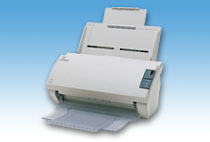
The scanner uses an automatic document feeder and supports simultaneous two-sided capture. PFU’s archived specification lists documents up to A3 or 11 by 17 inches and paper weights from 52 to 127 g/m². Its 100-sheet capacity is specifically stated for A4 at 80 g/m² (20 lb). That number should not be carried over to every paper size, weight or condition; the sources do not give an A3 stack limit for this exact record.
PFU’s model guide supports a long-page mode up to 297 by 864 mm. That can matter for unusually long receipts or forms, but the guide does not make the ADF suitable for every delicate, curled or unusually thick original. The page also lists ultrasonic multi-feed detection. A detector is a warning mechanism, not a guarantee against a double feed or damage. This is an ADF-only design; a glass platen or separate special-original manual-feed mode is not established by the reviewed exact-model material.
Published speed figures do not reconcile cleanly
The archived product page gives A4 portrait ratings at 200 dpi of 35 pages per minute and 35 images per minute for both color and binary capture, with higher 47 ppm/47 ipm figures in landscape orientation. The model-qualified driver guide gives a different table: black-and-white simplex/duplex rates of 35/17.5 ppm/ipm at 200 dpi, and color rates of 45/22.5 at 150 dpi. The test modes and printed numbers do not line up, so I do not select one as a universal duplex throughput claim. Both are manufacturer specifications; actual reading time may also vary with the host system, software and job.
The same product record lists 600 dpi optical resolution and a CCD sensor. Those technical figures describe the scanner design; they are not an independent image-quality test or a promise that a particular old unit still meets its original condition.
Two wired host routes, not a modern network workflow
PFU lists USB 2.0 and Ultra SCSI interfaces. Its guide also notes that SCSI use depends on a compatible host card and cable, and warns that an unlisted card can make operation unstable. A SCSI board, cable, power supply and paper chute should not be assumed to come with a used scanner. USB is the simpler documented route, but an older interface standard does not prove that a current computer has a working driver path.
PFU’s archived TWAIN32 page includes the fi-4530C among supported models, and its old system list stops at legacy Windows releases. The product page also lists TWAIN and ISIS support. This establishes historical driver interfaces—not compatibility with a present operating system, processor architecture, security policy or capture application. A separate Wi-Fi, mobile-device or computer-free cloud route is not documented in the sources reviewed here.
Software and package details need a careful check
The archived product page itself shows a software-version inconsistency: an Adobe Acrobat 7.0 promotional graphic appears alongside an accessory list naming Acrobat 6.0 Standard on CD. That is not a current package guarantee, and it does not establish transferable license rights. Treat the included software, media, drivers and licenses as unknown unless the seller identifies exactly what is present and the buyer verifies it can be used.
PFU’s U.S. maintenance instructions list the fi-4530C’s pick roller and pad assembly and give estimated replacement intervals. Those are maintenance guidelines on named paper, not a measure of a used machine’s remaining life. For a secondhand unit, ask about the page counter, roller and pad replacement, feed errors, cleaning history and a return window. The model’s service-discontinued status is a reason to check parts and repair options, not a claim that every scanner is unusable.
Who should consider it—and what to verify
The fi-4530C belongs on a narrow shortlist only when a buyer specifically needs an earlier A3-capable duplex ADF and can validate a compatible wired computer workflow. Its documented 100-sheet rating is useful for A4 loading, but the model is not a current wireless personal scanner, an all-purpose book scanner or a guaranteed plug-and-play choice for modern software. The fi-7480 link is a vendor-designated replacement destination, not proof that this older model is equivalent to the newer device.
Before purchase, verify the physical model label, the exact USB or SCSI route, the working driver/application/host combination, included power and paper-feed parts, duplex operation, consumable condition, seller return terms and any claimed software. Use the exact paper-loading instructions for the documents you intend to feed. No price, present stock, warranty transfer or seller condition is asserted here.
Sources: PFU America U.S. discontinued scanner roster; PFU/Ricoh archived fi-4530C specifications and image; PFU fi-4530C model-qualified driver guide; archived Fujitsu TWAIN32 model list; Fujitsu U.S. fi-4530C maintenance instructions.
Key specifications
Key details at a glance
| Scanner class | Professional departmental sheet-fed scanner |
|---|---|
| Automatic document feeder capacity | 100 sheets |
| Optical resolution | 600 dpi |
| Connection options | USB / Ultra SCSI |
| Automatic duplex capture | Yes |
| TWAIN driver documented | Yes |
Use the exact model’s instructions for operating limits, supplied equipment and version differences.
Sources for this review
Sources for this assessment
- PFU America U.S. discontinued-for-service scanner roster
- PFU America fi-7480 page reached from the fi-4530C roster link
- PFU/Ricoh archived exact fi-4530C model specifications
- PFU/Ricoh fi-4530C model-qualified driver guide P3PC-1382-07ENC2
- Archived Fujitsu TWAIN32 Version 9.18.210 model and OS list
- Fujitsu U.S. fi-4530C/fi-5530C consumable replacement and cleaning instructions
- PFU/Ricoh official archived fi-4530C page-linked scanner-body image

Compare the workflow before you choose
Use the finder to test your connection, paper and software requirements against the documented scanner arrangements.