
Your needs, this model
Does it fit your priorities?
Can I capture both sides of a batch automatically?
No. The exact PFU specification states simplex-only scanning. The ADF feeds one page side per pass, so two-sided originals require a manual second-side workflow in software or separate passes; do not equate the flatbed with duplex capture.
Explore this need in the finder →Is a 50-sheet one-load feeder documented, and is it also a daily volume rating?
PFU specifies a maximum 50 sheets at A4 80 g/m² (20 lb) per ADF loading and separately states up to 1,000 sheets per day. The first is a qualified load, the second a published duty figure; neither measures a particular old unit's feed reliability or remaining wear life.
Explore this need in the finder →Does its TWAIN listing guarantee that my current application will work?
No. PFU lists the fi-5015C on a version 9.19.922 TWAIN page with supported Windows editions through Windows 10, plus older server systems. That dated matrix does not establish a current OS build, application pairing or successful installation; verify the exact host and capture software before buying.
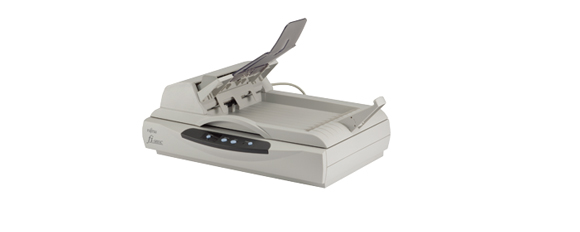
Explore this need in the finder →The Fujitsu fi-5015C is an earlier desktop scanner that combines an automatic document feeder with a flatbed. PFU America's U.S. service-status roster lists the model under Workgroup / Discontinued for Service. The matching archived PFU product page is explicit that its feed mode is simplex. The available primary material did not establish an exact U.S. sales part number or any current seller package, so this assessment stays at the model level and does not assume the historic software, power supply or cables are present in a used listing.
A modest stack feeder, but not automatic two-sided capture
PFU specifies up to 50 sheets at A4 80 g/m² (20 lb) in the ADF. That is a one-loading maximum on the stated stock, not a promise that a feeder of this age will accept every mixture or condition and not a daily output target. The company separately lists a daily-duty figure of up to 1,000 sheets. The distinction is useful: the first describes how much paper the tray can hold under its published basis; the second is a manufacturer's duty specification, not an observed result or recommendation for every environment.
The exact specification lists simplex mode only. It gives up to 15 pages per minute for monochrome/grayscale at 200 dpi, 9 ppm for color at 200 dpi, and 15 ppm for color at 150 dpi. These are different modes, and the color resolution changes the advertised speed. They are hardware figures rather than an independent test and do not include a particular computer's transfer, software, image cleanup or file-saving time. If a regular workflow includes duplex contracts or records, plan for a manual second-side process or choose a documented duplex model instead.
The platen is the special-original path
A flatbed can be valuable for a bound page, a delicate item or an original that should not be fed through rollers. The fi-5015C has that separate glass surface in addition to its ADF. But the platen does not turn its simplex feeder into an automatic duplex scanner, increase its 50-sheet loading capacity, or establish a distinct manual-feed bypass for unusual pages. PFU's exact page lists the feeder and flatbed separately and gives the maximum ADF dimensions; it does not provide a separate ADF manual-feed capability in the reviewed material.
The manufacturer's archived page states an optical resolution of 600 dpi, color CCD capture, 24-bit color and 8-bit grayscale output. Those are documented image-path capabilities; they do not guarantee how a specific faded, bound, textured or damaged original will look. Use the actual software and intended settings to validate a representative document before making the older scanner part of an important record workflow.
Plan around USB and dated software evidence
The technical specification lists USB 2.0. It does not list Wi-Fi or a network interface, so this is not a documented wireless or mobile-scanning choice. PFU's product description mentions programmable operator-panel destinations such as email, FTP, printing, PDF or a network share. That language is not enough to classify it as a standalone network scanner: the same exact specification lists USB 2.0 as the interface, and no computer-free cloud route is established here. Treat those destination labels as historical software/profile workflow claims that need to be checked against the actual installed software and host.
PFU lists TWAIN and ISIS in the archived model specification. Its version 9.19.922 TWAIN page names the fi-5015C and lists specific Windows 10, 8.1, 8, 7, Vista, XP and 2000 editions plus older Windows Server variants. That is more concrete than a generic TWAIN logo, but it remains a dated compatibility table. It does not prove support for a present operating-system build, the user's capture application, a current download entitlement, a transferable software license or a successful setup. Ask to test the exact host and application before relying on a used unit.
Size, maintenance and package uncertainty
PFU lists a 5.5 kg body and base dimensions in its archived specification. Its printed dimension heading is H × W × D; the values are kept in that order in this assessment rather than relying on a rounded conversion. Allow additional room for the feed chute, output, lid opening and flatbed access. The image shows the scanner body and physical controls only; it is not a picture of any seller's unit, accessories or software package.
The page identifies a pad assembly and pick roller and gives replacement intervals of 20,000 sheets or one year for the pad, and 100,000 sheets or one year for the roller. Those are manufacturer maintenance figures, not evidence about the condition or remaining life of a particular old machine. Confirm part fit, actual wear, feeder behavior, clean glass, power adapter, USB cable, software and return terms with the seller. An old page's included-box table should not be mistaken for current package contents.
Compared with other earlier flatbed/ADF models
The fi-4220C2 is a meaningful alternative if duplex feeding matters: its exact U.S. model sheet documents automatic duplex at a 50-sheet loading tier and a flatbed, but it is a different model with a different part number and a more complicated selectable USB/SCSI host choice. The fi-5220C is another duplex ADF-plus-flatbed configuration whose exact U.S. sales part was not established here. The fi-5015C's simpler USB-only listed connection may reduce interface ambiguity, but its simplex feed is the decisive limitation. It should not be chosen as a bargain substitute for automatic two-sided capture.
Who this assessment fits
The fi-5015C is worth considering only for a buyer who can verify an earlier USB/TWAIN or ISIS workflow, wants a flatbed and accepts simplex ADF capture. It is not a documented match for automatic duplex, Wi-Fi, mobile scanning, guaranteed current driver support or computer-free cloud. Before purchase, confirm the exact model label, test ADF and platen operations on the intended computer, inspect the glass and consumables, establish the software needed for any panel destination, and verify the seller's actual package and return terms. Neither the roster status nor a historical specification proves the condition, completeness or compatibility of an individual unit.
Key specifications
Key details at a glance
| Scanner class | Flatbed simplex adf document scanner |
|---|---|
| Manufacturer-listed simplex rate | 15 ppm |
| Automatic document feeder capacity | 50 sheets |
| Optical resolution | 600 dpi |
| Connection options | USB |
| Automatic duplex capture | No |
| Touchscreen | No |
| TWAIN driver documented | Yes |
Use the exact model’s instructions for operating limits, supplied equipment and version differences.
Sources for this review
Sources for this assessment

Compare the workflow before you choose
Use the finder to test your connection, paper and software requirements against the documented scanner arrangements.