
Your needs, this model
Does it fit your priorities?
Can I ask the finder for a 500-sheet fi-5950 minimum?
No. The finder asks for a minimum ADF load only up to 200 sheets; selecting 200 does not mean the feeder holds only 200. PFU's exact fi-5950 table rates up to 500 A4/Letter sheets at 80 g/m2 (20 lb) with the hopper lowered, while the Operator's Guide gives 100, 300 and 500 at its high, middle and low settings and says capacity changes with paper thickness. Treat 500 as a qualified one-loading figure, not a daily-volume promise or a guarantee for a worn machine.
Explore this need in the finder →Does fi-5950 manual feed create a second tray or glass surface?
No. The exact Operator's Guide describes Single Feed for one manually inserted sheet at a time and Continuous Feed for manually inserting successive sheets, both through the ADF. It names thick paper, envelopes and folded paper as examples; this is not a flatbed or a bypass tray. Manual-mode multifeed detection is separately configurable, so verify that setting and the exact stock limits rather than assuming automatic-stack safeguards remain unchanged.
Explore this need in the finder →Is 135 ppm or the published daily volume a result for my document queue?
No. PFU lists up to 135 ppm / 270 ipm at A4 landscape and 200 or 300 dpi, with lower A4 portrait figures of 105 ppm / 210 ipm. The U.S. brochure gives 60,000-100,000 expected sheets per day; the Global product page also states up to 100,000 in feature copy but 120,000 in its specifications table. These are manufacturer claims, not tests, and the daily-volume statements conflict. Preparation, host transfer, recognition, stock, review and stops affect real work, so this assessment assigns no single daily capacity.
Explore this need in the finder →What should a buyer verify about its host and optional hardware?
The historical U.S. catalog lists a USB-to-host route and PaperStream IP TWAIN/ISIS, while PFU now lists the model as discontinued. Do not infer support on a present operating system, a transferable software license or a current part-specific carton. Confirm the exact USB or SCSI interface, driver/application support, any CGA/VRS board or imprinter claim, rollers, counter/service history, included cables/media, return terms and whether any service coverage transfers to the actual unit.
Explore this need in the finder →Assessment basis: a research-based review of PFU/Fujitsu's U.S. product catalog, exact-model specifications and operating instructions—not a hands-on test. No scanner, throughput, feed reliability, image quality, condition or current seller unit was tested.
A high-volume production feeder, not a flexible office all-rounder
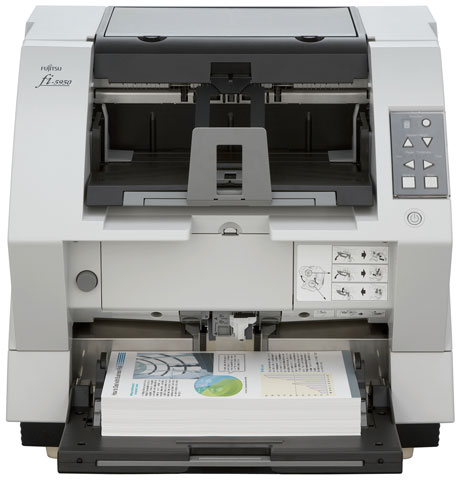
PFU America places the fi-5950 in its Production group and marks it no longer available for sale. The exact model is an older duplex ADF machine intended for large document batches. The reviewed sources do not identify a separate glass platen, a second bypass tray, wireless networking or a computer-free cloud route. Its documented USB workflow depends on a host computer and capture software.
Physical planning is a real threshold, not a small-print detail. The manufacturer's U.S. sheet lists a 50 kg (about 110 lb) scanner body and dimensions of 540 × 540 × 500 mm, excluding the feeder hopper and stacker. It also gives a much larger installation-space figure—940 × 1,740 × 500 mm—so confirm both the support surface and the room needed to load and collect paper. Those published dimensions are not a fit measurement of a particular site or used unit.
Capacity is a per-loading figure with a paper basis
The headline feeder figure is up to 500 A4/Letter sheets at 80 g/m² (20 lb) with the hopper in its lower position. The Operator's Guide describes three hopper heights, up to 100, 300 or 500 sheets on that basis, and cautions that paper thickness changes the usable load. The U.S. catalog lists different paper-weight ranges for A4/Letter-or-smaller versus larger originals. Do not read “500” as capacity for every mixed-stock batch, or as a guaranteed count from a machine whose rollers and feed path may have an unknown history.
The model does have a documented way to handle certain individual originals outside a routine automatic stack: the guide describes Single Feed and Continuous Feed modes that manually introduce sheets through the ADF. It names thick paper, envelopes and folded paper as examples. Continuous Feed still means loading successive sheets one at a time; neither mode adds another tray or a glass surface. Manual-mode multifeed detection is separately configurable and can be disabled or made to follow driver settings, so check that behavior and the exact material limits before relying on it for irregular originals.
Published speed needs its orientation and workflow attached
PFU publishes up to 135 pages per minute simplex or 270 images per minute duplex for A4 landscape at 200 or 300 dpi; its A4 portrait row is 105 ppm or 210 ipm. These manufacturer ratings vary with the system environment. Transfer, software processing, setup, document preparation, review, jams and operator coverage all affect an actual queue, and this research did not measure scan time.
Daily-volume statements are less tidy. The 2013 U.S. brochure gives 60,000–100,000 expected sheets per day. The later Global page says up to 100,000 sheets in its feature copy, but lists 120,000 in its specification table. Because the source statements conflict, this assessment does not assign one daily-volume figure or treat either as a guarantee. A feeder's one-time load and a vendor's stated daily duty range answer different questions.
Host, software and optional hardware must be verified
The listed interfaces are USB and Ultra Wide SCSI alternatives, not simultaneous connections. The exact U.S. model material names a USB 2.0/1.1 computer path and historical TWAIN/ISIS drivers, including PaperStream IP. It does not establish that a current computer, operating system, scanner application or license will work. Before considering an older machine, identify its actual port and board, find a supported driver for the intended host, and confirm that the capture application can see the installed device.
Do not assume all fi-5950 units include the same options. The U.S. catalog marks the CGA/VRS board as optional; pre- and post-imprinters are also optional and print on different sides at different stages. Both imprinters may be attached, but the manufacturer says they cannot be used simultaneously. Historical package lists and software names do not prove that a used seller's device includes the board, media, cables, license or installed feature.
Age makes maintenance and the exact offer part of the decision
PFU's consumables listing names fi-5950 feed and separation parts and gives a reference replacement interval of 600,000 sheets. That is a maintenance guide, not a service record; PFU bases the estimate on A4 64 g/m² paper and notes that other stocks change the interval. Ask for the unit's counter or service history, inspect the actual feed path, and confirm the exact replacement parts and service scope rather than inferring condition from a model specification.
PFU's U.S. discontinued roster says the model is no longer for sale but remains eligible for extended service coverage. That status does not identify a current scanner listing or prove that coverage transfers to a subsequent owner. No U.S. part number, seller package, condition, present scanner-body offer, price or availability was verified for this review. Confirm the exact model label, included accessories, interface, optional equipment, operating host, return terms and any second-hand service eligibility with the actual seller.
Where it sits beside other production models
On paper, the fi-5950's qualified 500-sheet A4/Letter load is larger than the 300-sheet basis documented for the current-reference fi-7600. The newer model has its own USB host path and separate Manual/Single mode; the fi-5950 is an earlier machine whose host and maintenance history need separate scrutiny. The earlier fi-6670A is a different ADF-only configuration with a 200-sheet Letter/20-lb loading basis. These are useful specification comparisons, not a finding that one will scan a particular real-world job faster or more reliably.
The fi-5950 may merit investigation only when an existing production workflow can use its large duplex feeder and the organization can validate the exact unit, paper routine and legacy host. For a prospective purchase, the more difficult questions are not its headline ppm: they are the actual hardware revision, feeder condition, supported software path, included options, physical installation, parts history and return or service terms.
Key specifications
Key details at a glance
| Scanner class | Professional production sheet-fed scanner |
|---|---|
| Manufacturer-listed simplex rate | 135 ppm |
| Manufacturer-listed duplex image rate | 270 ipm |
| Automatic document feeder capacity | 500 sheets |
| Optical resolution | 600 dpi |
| Connection options | USB / Ultra Wide SCSI |
| Automatic duplex capture | Yes |
| Separate manual-feed route | Yes |
| Touchscreen | No |
| TWAIN driver documented | Yes |
Use the exact model’s instructions for operating limits, supplied equipment and version differences.
Sources for this review
Sources for this assessment
- PFU America U.S. discontinued-scanner roster
- PFU/Ricoh Global: archived exact-model fi-5950 profile and specifications
- Fujitsu U.S. fi-5950 catalog sheet (2013 edition; official PDF-reader observation)
- PFU/Ricoh: exact fi-5950 datasheet (December 2019 edition)
- PFU/Ricoh fi-5950 Operator's Guide P3PC-3052-05ENZ0
- PFU/Ricoh Global: fi-5950 English manual index
- PFU/Ricoh Global exact fi-5950 product-page image
- PFU/Ricoh fi-series consumables and maintenance-parts list

Compare the workflow before you choose
Use the finder to test your connection, paper and software requirements against the documented scanner arrangements.