
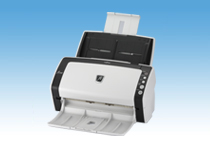
Your needs, this model
Does it fit your priorities?
Can the fi-6140 cover a wired 50-sheet duplex workflow when capture software requires TWAIN?
At the documented model level, yes: PFU lists USB host capture, automatic duplex and TWAIN/ISIS; the active ADF load is 50 A4 sheets at 80 g/m², with the guide adding a 5 mm stack-height limit. This does not confirm a particular used unit, host architecture, application, driver file or software license, so test the exact setup before relying on it.
Explore this need in the finder →Does Manual Feeding give the fi-6140 a second tray for occasional originals?
No. The non-Z fi-6140/fi-6240 guide describes an operator loading one sheet at a time through the same ADF while a configurable timeout waits for the next original. The fi-6140 has no flatbed; that is the fi-6240 distinction. The guide does not settle Paper Protection behavior specifically in this mode.
Explore this need in the finder →Can the fi-6140 scan to a phone or cloud service directly over Wi-Fi?
No scanner-side wireless or computer-free cloud route is documented. The exact model page lists selectable USB or Ultra SCSI host interfaces. Any later cloud transfer would depend on external host software and its compatibility, not an integrated network path established for this model.
Explore this need in the finder →The base Fujitsu fi-6140 is an earlier ADF-only duplex scanner with a 50-sheet loading limit under a specified paper basis. It is not the suffix-Z fi-6140Z, and it is not the fi-6240, whose shared manual adds a flatbed. Those names are easy to blur when shopping for old equipment, but they describe different models and their evidence should not be swapped.
Who the fi-6140 may suit
Its documented job is a computer-connected stream of loose office pages. PFU's archived profile lists single- and two-sided capture, color, grayscale and monochrome, with a Type-B USB connection or an alternative Ultra SCSI interface. The manufacturer lists TWAIN and ISIS drivers. That combination is relevant if a specific legacy workstation or capture workflow already supports the scanner; it is not a plug-and-play promise for a current computer. There is no documented Wi-Fi, mobile-device route or scanner-to-cloud path without a computer.
The Departmental entry in PFU America's U.S. “Discontinued for Service” roster identifies the exact base-model name fi-6140 and says models in that section are no longer eligible for extended service coverage. The roster links this row to the fi-7180 replacement page. That is a replacement pointer, not evidence that the fi-7180 and fi-6140 are interchangeable. The listing establishes a historical U.S. model identity, not an exact sales part, current listing, seller package or the condition of a used unit.
Read the feeder specification as a condition, not a guarantee
PFU rates the active ADF load at up to 50 A4 sheets using 80 g/m² (20 lb) paper. The Operator's Guide adds a maximum stack height of 5 mm and explains that the permitted number changes with sheet size and weight. The archived Global profile and English guide list 41–210 g/m², with A8 sheets limited to heavier stock. PFU's Japanese fi-6140 specification page instead ends that range at 209 g/m². The one-gram difference is left unresolved across regional sources; the U.S. roster does not identify a sales part, so verify the exact unit's documentation before relying on that edge. A stack that fits by sheet count can still exceed the height or media limits, so do not treat “50 sheets” as a universal batch size.
The speed table also needs its settings attached. For portrait A4 at 200 dpi, PFU lists color at 40 pages per minute / 80 image sides per minute and grayscale or monochrome at 60 / 120. At 300 dpi the listed modes fall to 40 / 80. The color figures are JPEG-compressed, and the manufacturer notes that transfer and software processing affect actual time. These are published maximum tiers, not measured performance on an older unit or a prediction for a particular computer.
The ADF handles up to legal-width pages and the archived profile lists long-document scanning to 120 inches. PFU limits lengths over 34 inches to TWAIN at 200 dpi or lower. The model page also documents embossed-card feeding, with a three-card continuous-feed limit and no support for feeding multiple embossed cards together; its more favorable thickness note is tied to monochrome 200-dpi scanning. This is a paper feeder, not a general-purpose route for photographs or every unusual original. The guide warns about photos, nonuniform, folded, torn, coated, perforated, very thin or wet-ink sheets, and calls out clipped or stapled documents and materials other than paper as unsuitable. For a valuable or delicate original, do not infer safety from a “paper protection” feature: the guide says that setting can stop on folded or nonstandard thin paper, but does not guarantee that a sheet cannot be damaged.
One-at-a-time feeding is still the same ADF
The fi-6140 / fi-6240 guide describes a Manual Feeding mode in which the operator loads sheets one at a time. If another batch is loaded before the configured timeout, multiple batches can continue as one file; otherwise scanning ends when the timeout expires. This is useful context for a small number of originals that do not belong in an ordinary stack, but it is not a second inlet or a glass bed. The fi-6140 itself remains ADF-only; a flatbed is the fi-6240 distinction.
Legacy interfaces and ownership checks matter more than the headline speed
USB 2.0/1.1 and Ultra SCSI are selectable alternatives, not concurrent connections. A SCSI workflow requires the right host adapter and working driver; even the USB route still depends on the scanner driver, operating-system architecture, capture application and any software license. PFU's archived page is explicitly marked out of date and lists older driver-era material, so it cannot establish present-day support for a specific Windows release or app. Before relying on a used unit, confirm the exact nameplate, connection, driver files and a successful test on the intended host.
Rollers are another practical consideration. PFU lists brake roller PA03540-0001 and pick roller PA03540-0002 with guideline replacement intervals of 200,000 sheets or one year. The guide says that figure is a rough interval based on specified paper and varies with media, usage and cleaning. It does not reveal a seller's page count, service history, present wear or whether the parts are available. Ask about the counter, roller replacement, jams, cleaning, return conditions and power/USB accessories rather than assuming an old package list describes today's box.
Bottom line
The fi-6140 is a plausible assessment only for someone who specifically needs an earlier, wired ADF with automatic duplex, legacy TWAIN/ISIS documentation and a qualified 50-sheet load. Its lack of a flatbed, network path and current-host guarantee narrows the use case. For most buyers, the age and software checks are as important as the published throughput. Treat any seller's unit as a separate condition-and-package decision, and do not buy on the basis of a replacement link or a neighboring fi-6140Z review.
Research basis: PFU America U.S. discontinued scanner roster, the archived exact-model fi-6140 profile, and its fi-6140 / fi-6240 Operator's Guide. This is a source-based assessment, not a hands-on test, and it does not establish a current offer, exact U.S. part, seller package or individual-unit condition.
Key specifications
Key details at a glance
| Scanner class | Professional departmental sheet-fed scanner |
|---|---|
| Automatic document feeder capacity | 50 sheets |
| Optical resolution | 600 dpi |
| Connection options | USB / Ultra SCSI |
| Automatic duplex capture | Yes |
| Separate manual-feed route | Yes |
| Touchscreen | No |
| TWAIN driver documented | Yes |
Use the exact model’s instructions for operating limits, supplied equipment and version differences.
Sources for this review
Sources for this assessment

Compare the workflow before you choose
Use the finder to test your connection, paper and software requirements against the documented scanner arrangements.