
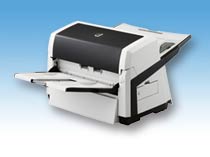
Your needs, this model
Does it fit your priorities?
Is the fi-6670A a USB duplex scanner, and can it use Wi-Fi?
PFU's U.S. family datasheet lists USB 2.0 for the A model, and exact Global material identifies it as duplex with TWAIN/ISIS. The reviewed model sources do not establish Wi-Fi, phone scanning or a PC-free cloud path. USB and SCSI are alternative interfaces, not a promise of simultaneous host links.
Explore this need in the finder →Does the fi-6670A really take a 200-sheet loading?
The U.S. family datasheet rates the ADF at 200 sheets for Letter 20 lb paper. Maximum load changes with paper weight and the condition of an individual used feeder, so treat this as the manufacturer's loading basis rather than a guaranteed batch result. The unit is rated at 90 ppm / 180 ipm only at A4 landscape 200 dpi; published speeds are not an independent throughput test.
Explore this need in the finder →Can it handle books or special originals one by one?
No glass platen is documented for the fi-6670A; the shared manual assigns the flatbed to the distinct fi-6770(A). The fi-6670A guide does describe sheet-by-sheet manual feeding through its ADF, but that is not a separate bypass tray. Embossed cards are excluded, and paper weight/size limits still apply, so do not treat the manual mode as safe handling for every fragile original.
Explore this need in the finder →What must I verify before installing this earlier model?
Its body is listed at 25.2 by 17.0 by 11.8 inches and 37.5 lb before the ADF chute and stacker are counted; the published installation-space figure is larger. Confirm the physical port and cable, available compatible driver and Kofax VRS licensing/media, the target computer and the exact seller's package and return terms. The U.S. roster's service statement is not proof that service transfers with a used scanner.
Explore this need in the finder →Assessment basis: this is a document-based review of manufacturer material, not a hands-on test. No scanning speed, feed reliability, image quality, current resale availability or used-unit condition was measured.
A production ADF, not a flexible home-office machine
Treat the fi-6670A as a discontinued production feeder for a team with compatible computer software and large two-sided batches. It offers a wide 200-sheet ADF and duplex capture but no flatbed; the distinct fi-6770A has the platen. Model suffixes matter if books, delicate pages or irregular originals need glass.
The U.S. roster lists the exact fi-6670A as no longer for sale, though eligible for extended service; that does not prove a live offer or transferable secondhand coverage. Its replacement link opens a separate fi-7600 page, not a claim that an old unit is a modern equivalent. See the PFU America roster before considering this earlier model.
The A suffix is a real configuration distinction
PFU's archived exact-model page describes the fi-6670A as a duplex ADF scanner with a standard Color Graphics Accelerator board and Kofax VRS image-processing features. The shared operator guide likewise separates the A variant's CGA board from the plain fi-6670, so an unsuffixed listing is not a safe substitute. Historical bundle text identifies the original design; it does not prove that a used seller still has the software, license, installation media or cable.
Fast ratings have a stated orientation and a source conflict
The most consistently supported headline rate is up to 90 pages per minute or 180 images per minute for A4/Letter landscape originals at 200 dpi. Duplex means both sides are captured in the pass, so ipm counts image sides rather than sheets. That is the scanner's rate, not a job time; the driver, host and paper handling affect results.
There is a meaningful qualification at 300 dpi. PFU's exact fi-6670A Global table lists 80 ppm/160 ipm for that setting and then annotates 148 ipm with its bundled CGA board. The older U.S. family datasheet also shows 80/160 at 300 dpi, but its speed table groups fi-6670 and fi-6770 without distinguishing the A variants. Because the exact-model and family tables do not reconcile cleanly for the A configuration, this review does not promise a 300-dpi duplex rate. If that speed is a procurement requirement, ask the seller or service provider to identify the actual board, driver and scan mode and arrange a representative acceptance test rather than extrapolating from the 200-dpi figure.
A 200-sheet rating still depends on the paper
The U.S. fi-6x70 datasheet states a 200-sheet ADF capacity for Letter-size 20 lb paper. PFU's exact-model technical page warns that maximum load varies with paper weight. The rating is therefore a loading reference, not a guarantee that an aged roller set, mixed stock or every sheet size will feed a full stack without attention. Use the operator guide for the exact weight and size conditions; the approved weight ranges differ for Letter-size-or-smaller paper, larger stock and A8 originals.
The ADF reaches up to 11 by 17 inches according to the U.S. datasheet, with the exact Global model sheet describing A3 portrait as its maximum. The older technical material also gives conditional long-paper limits: the TWAIN/ISIS route reaches 120 inches only at 200 dpi or below, with shorter limits at higher resolutions, and VRS has its own limit. A long original is not simply a normal batch sheet, and it should not be loaded without checking the specific driver and resolution instructions.
Manual feeding is through the ADF, not a second input path
The Operator's Guide describes a sheet-by-sheet Manual Feeding mode: a later load can join a scan sequence if placed before the wait timeout. It is not a bypass tray or flatbed. A separate operator-assisted mode lets someone inspect a multifeed alert, including a note overlap, but that is not a guarantee for delicate stock. The exact-model page allows ISO 7810 cards but excludes embossed cards; other originals still have to meet the ADF's size, thickness and weight limits.
Plan for USB-era software and a substantial footprint
The U.S. family sheet identifies USB 2.0 and Ultra SCSI interfaces for the A variants. The exact-model Global specifications explain that USB and SCSI are alternative connections, not a way to attach multiple computers at once. This assessment therefore treats USB-connected capture as the practical finder route, but it does not assume a current computer will accept the legacy driver or that an old TWAIN/ISIS application still runs on today's operating system. Confirm the precise hardware revision, available cable, driver source, VRS license and target capture software before purchasing. Wi-Fi, phone scanning and computer-free cloud sending are not established in the model sources reviewed here.
Desk fit deserves equal attention. The Global sheet lists a body about 25.2 inches wide, 17 inches deep and 11.8 inches high at roughly 37.5 lb, excluding the ADF chute and stacker; its installation-space figure is wider and deeper still. Measure the work surface and clearance with its loading and output trays deployed, and check that the receiving stand can support the weight. The machine's production label does not replace ordinary room, cable and operator-access planning.
Who should keep it on a shortlist?
The fi-6670A is a narrow, conditional candidate for a team with compatible legacy capture software, a need for a wired duplex feeder and space for a heavy ADF-only chassis. Verify the A suffix, board and connectors, roller condition, chute/stacker, cable, software license, seller package and return terms; the old datasheet cannot settle those seller facts.
Skip it if you need glass, wireless or mobile scanning, assured current OS support, a documented present-day service arrangement or a predictable 300-dpi rate. Its 200-dpi speed and 200-sheet capacity are useful specifications, not proof that an unknown-condition used unit is a reliable production system. Check the exact hardware, media and software against your own workflow.
Primary references: PFU/Ricoh exact fi-6670A specifications, the U.S. fi-6x70 datasheet, and the fi-6x70(A) Operator's Guide.
Key specifications
Key details at a glance
| Scanner class | Professional desktop sheet-fed scanner |
|---|---|
| Manufacturer-listed simplex rate | 90 ppm |
| Manufacturer-listed duplex image rate | 180 ipm |
| Automatic document feeder capacity | 200 sheets |
| Optical resolution | 600 dpi |
| Connection options | USB / Ultra SCSI |
| Automatic duplex capture | Yes |
| Separate manual-feed route | Yes |
| TWAIN driver documented | Yes |
Use the exact model’s instructions for operating limits, supplied equipment and version differences.
Sources for this review
Sources for this assessment
- PFU America U.S. discontinued-scanner roster
- Fujitsu U.S. fi-6670/fi-6770 family datasheet
- PFU/Ricoh Global archived exact-model fi-6670A page and technical table
- PFU/Ricoh fi-6670(A)/fi-6770(A)/fi-6750S Operator's Guide
- PFU/Ricoh fi-6670(A)/fi-6770(A)/fi-6750S Getting Started
- PFU/Ricoh Global fi-6670A/fi-6770A manual index
- PFU/Ricoh Global exact-model fi-6670A product image

Compare the workflow before you choose
Use the finder to test your connection, paper and software requirements against the documented scanner arrangements.