
Your needs, this model
Does it fit your priorities?
Does the fi-6770A have a glass platen as well as a duplex feeder?
Yes. The shared PFU guide identifies fi-6770(A) as the ADF-plus-flatbed type; the exact-model page specifies an A3/double-letter platen up to 11 by 17 inches. This is the important difference from the ADF-only fi-6670A. The U.S. family sheet's 12-by-18-inch figure is for non-A fi-6770, so do not transfer it to the A model.
Explore this need in the finder →Is the 200-sheet feeder rating suitable for every stock?
No. The U.S. family sheet states 200 Letter sheets at 20 lb and the exact Global model page states 200 sheets at A4 80 g/m2/20 lb, with maximum loading dependent on paper weight. Treat it as a qualified per-load rating, not a guarantee for mixed paper or an unknown-condition used feeder. The flatbed is a separate one-original route and does not increase the ADF capacity.
Explore this need in the finder →Can I use its glass for books and still scan stacks on both sides?
The model has a duplex ADF plus a separate platen, and the shared guide describes the glass path for thin paper or thick books. The ADF also offers a manual-feed mode for loading one sheet at a time, but that is not another tray and it does not replace the platen. Check the particular original against the ADF's size/weight limits or the platen dimensions before scanning.
Explore this need in the finder →What should a used fi-6770A buyer verify before relying on it?
The body is rated at 77.2 lb before the chute and stacker; PFU's installation-space figure is about 40.6 by 27.6 inches before adding operator access. Verify the exact A-suffix and platen, working USB interface/cable, driver and capture-software route, VRS license/media, roller condition, page limits, seller package and return terms. The discontinued roster's service wording does not establish transferable coverage.
Explore this need in the finder →Assessment basis: this is a research-based review of manufacturer specifications and instructions, not a hands-on test. No scan time, image quality, feed reliability, present availability or condition of a used unit was measured.
A production feeder with a glass route
The fi-6770A combines two different jobs: a duplex automatic document feeder for stacks and a flatbed for originals that should be placed individually on glass. That makes the model more flexible than the ADF-only fi-6670A, but it is not a small office scanner. The U.S. PFU roster places the exact fi-6770A in its Production group and says listed models are no longer available for sale, although still eligible for extended service. That wording is not proof of a live offer or service eligibility for a secondhand buyer.
The separate platen is the practical reason to consider this exact suffix. PFU's shared operator guide identifies the fi-6770(A) as the flatbed type and describes using the glass for thin sheets or thick books. The exact-model Global specification lists a flatbed area up to A3/double-letter, 11 by 17 inches. A U.S. family sheet gives a larger 12-by-18-inch platen for the unsuffixed fi-6770 only; it does not assign that limit to the A variant, so do not assume the bigger surface without a model-specific manual or confirmation.
The A suffix denotes a bundled processing board, not a seller package
PFU's shared startup guide and archived model page identify a standard Color Graphics Accelerator (CGA) board in the fi-6770A. The product page associates it with Kofax VRS image-processing functions such as automatic orientation and color recognition. Those are part of the documented design, not a promise that a used listing includes working software, an active license or installation media. Verify the physical suffix and internal configuration, then ask the seller to identify exactly what software and rights transfer.
This model is also distinct from the fi-6750S: the shared guide says that scanner's ADF is simplex, while fi-6770A supports automatic duplex. An unsuffixed fi-6770 is a related but not identical configuration. An offer titled only “fi-6770” should not be treated as proof that the A-model board, connectors or software bundle is present.
Published speed depends on direction and resolution
The most consistently supported ADF headline is up to 90 pages per minute and 180 images per minute for landscape originals at 200 dpi. PFU's U.S. family sheet states that rate for Letter; the exact Global page states it for A4. The same exact page gives 70 ppm/140 ipm for portrait at 200 dpi. Duplex captures both sides in one pass, so images per minute counts page sides, not sheets. These are manufacturer ratings, not an observed job-time estimate: software processing, host transfer, paper handling and the chosen mode still matter.
The 300-dpi duplex figure is less clear. The exact Global table lists 80 ppm/160 ipm, then separately notes 148 ipm with the CGA board. The U.S. family table also lists 80/160, but it groups A and non-A models. Because the sources do not settle one A-variant rate under that configuration, this review does not promise either value as the fi-6770A's 300-dpi duplex throughput. If that mode is essential, request a demonstration on the exact unit and software path.
The 200-sheet rating is a stock-specific loading guide
The U.S. family datasheet specifies a 200-sheet ADF for Letter paper at 20 lb. The exact Global page states 200 sheets for A4 at 80 g/m²/20 lb and warns that capacity changes with paper weight. Its allowed media ranges vary by size: lighter paper is supported on Letter-size-or-smaller stock than on larger sheets, while A8 originals have a heavier minimum. Treat 200 sheets as a manufacturer loading basis for suitable paper, not a guarantee for mixed batches or a feeder whose rollers may be worn.
The ADF accepts originals up to A3 portrait/double-letter and down to A8, about 2 by 3 inches. The Global page lists ISO 7810 cards but excludes embossed cards. It also publishes long-page limits that depend on the driver and resolution: the 120-inch route is limited to 50–200 dpi with TWAIN/ISIS; VRS has a shorter 34-inch limit at up to 300 dpi. A long receipt or unusually thick item should be checked against the exact operator instructions before it enters the feeder.
Glass and manual ADF feeding solve different problems
The platen gives a one-original path for bound or delicate material that should not travel through rollers. It does not make every book or fragile object fit the scanner, and the 11-by-17-inch maximum still applies. The manual describes a separate ADF manual-feeding mode for loading one sheet at a time while the device waits for the next page. That can help when pages need to be staged individually, but it is not a bypass tray and does not replace the flatbed. The flatbed likewise adds no sheets to the automatic feeder's capacity.
The model page also lists ultrasonic multifeed detection and the CGA/VRS processing functions. Those are useful safeguards and image-processing features, not guarantees against a jam, missed feed, overlap or damage. A used machine's maintenance history, separation rollers and cleaning state are unknown until a specific unit is inspected.
Measure the work area and check the old host path
PFU lists the scanner body at about 27.2 inches wide, 19.7 inches deep and 13.5 inches high, weighing 77.2 pounds. The dimensions exclude the ADF chute and stacker; the listed installation-space figure is about 40.6 by 27.6 by 25.2 inches. This calls for a sturdy, level support surface and room for loading, output and operator access. Confirm the stand rating and path into the room rather than treating the outer body dimensions as the complete footprint.
The U.S. family sheet identifies USB 2.0 and 68-pin or 50-pin Ultra SCSI configurations for the A models. The exact Global page says USB and SCSI are alternative host connections, not simultaneous links. It lists TWAIN and ISIS, ScandAll PRO and VRS-related software in its historic environment; the operating-system illustrations are old and do not establish current driver availability or compatibility with today's Windows, Mac, Linux, ARM or capture applications. Check the particular unit's board, connector, cable, driver source, license and target software before relying on it.
Who should keep the fi-6770A on a list?
It is a conditional candidate for a team that needs both a high-capacity duplex feeder and a separate platen, has sufficient floor or desk space, and can support a legacy wired capture setup. Its flatbed is a meaningful upgrade over an ADF-only sibling, not evidence that its feeder is faster or larger.
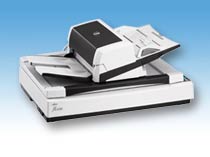
Before considering any offer, verify the complete fi-6770A label, the flatbed glass and hinges, both scanning paths, the ADF rollers, USB/SCSI hardware, tray and stacker, power lead, driver/application route, VRS license, seller package and return terms. Do not infer that the original setup DVDs or service coverage transfer. The archive image below identifies the model body only, and the roster's service statement is not a resale guarantee.
Primary references: the archived exact-model fi-6770A page, the U.S. fi-6x70 family datasheet, the shared fi-6x70 Operator's Guide and the PFU America discontinued roster.
Key specifications
Key details at a glance
| Scanner class | Professional desktop flatbed adf |
|---|---|
| Manufacturer-listed simplex rate | 90 ppm |
| Manufacturer-listed duplex image rate | 180 ipm |
| Automatic document feeder capacity | 200 sheets |
| Optical resolution | 600 dpi |
| Connection options | USB / Ultra SCSI / Ultra Wide SCSI |
| Automatic duplex capture | Yes |
| Separate manual-feed route | Yes |
| TWAIN driver documented | Yes |
Use the exact model’s instructions for operating limits, supplied equipment and version differences.
Sources for this review
Sources for this assessment
- PFU America U.S. discontinued-scanner roster
- Fujitsu U.S. fi-6670/fi-6770 family datasheet (PDF reader observation)
- PFU/Ricoh archived exact-model fi-6770A product and specification page
- PFU/Ricoh fi-6670(A)/fi-6770(A)/fi-6750S Operator's Guide
- PFU/Ricoh fi-6670(A)/fi-6770(A)/fi-6750S Getting Started
- PFU/Ricoh exact fi-6770A model-page image

Compare the workflow before you choose
Use the finder to test your connection, paper and software requirements against the documented scanner arrangements.