
Your needs, this model
Does it fit your priorities?
Does the fi-7160 meet a USB-connected capture workflow that needs automatic duplex and TWAIN?
PFU's U.S. model page identifies USB and integrated TWAIN/ISIS; the exact Global table lists the same driver family and USB 3.0/2.0/1.1. Its U.S. page says USB 3.2, so treat USB host capture as established but verify the exact generation, cable and driver on the actual unit.
Explore this need in the finder →Does an 80-sheet ADF and a 60/120 rate mean a 9,000-page daily guarantee?
No. The rated feeder is 80 sheets on A4 80 g/m² or Letter 20 lb paper, and PFU says that maximum can vary with paper weight. The 60 ppm/120 ipm speed is manufacturer-rated at stated settings; the 9,000-sheet expected daily figure is calculated planning guidance, not independent endurance testing or a guaranteed result.
Explore this need in the finder →Is the fi-7160's LCD a touchscreen or a replacement for a flatbed?
The Global product page describes a backlit LCD and physical controls; it does not establish touchscreen profile selection. The model is an ADF machine without a flatbed in the inspected exact-model references, so bound and delicate originals still need a separate documented platen or another workflow.
Explore this need in the finder →Review basis: This is a researched assessment of the U.S. fi-7160 scanner model, not a personal test. PFU America identifies it on its U.S. model page and lists it as discontinued in its Workgroup roster. That roster says its models are no longer for sale but remain eligible for extended service; it does not prove a seller has a working unit or that any service term transfers. No U.S. SKU or seller package was established here.
Higher published ADF rate, same 80-sheet tier
The fi-7160 is an automatic duplex sheet-fed scanner rated by PFU at up to 60 pages per minute and 120 images per minute for A4 portrait at 200/300 dpi. The figures describe the scanner's specified capture rate, not a complete document-processing job. Paper preparation, color mode, image cleanup, OCR, transfer speed and the destination application all affect elapsed time. PFU's exact-model datasheet gives an expected daily volume of 9,000 sheets, calculated using its speed rating and typical scanner-use hours. That is planning guidance, not a durability rating or a guaranteed daily workload.
The ADF is specified for 80 sheets on A4 80 g/m² or Letter 20 lb paper. PFU says that maximum varies with paper weight. The faster 60/120 rating therefore does not change the number of sheets held in one load: the fi-7160 remains an 80-sheet feeder, not a larger-capacity alternative to a 100-sheet or production scanner. The datasheet also lists a legal-size ADF maximum and paper/card limits; check the exact manual for your stock rather than assuming that every mixed stack can be loaded to its maximum.
Compact body with an LCD, not a touchscreen claim
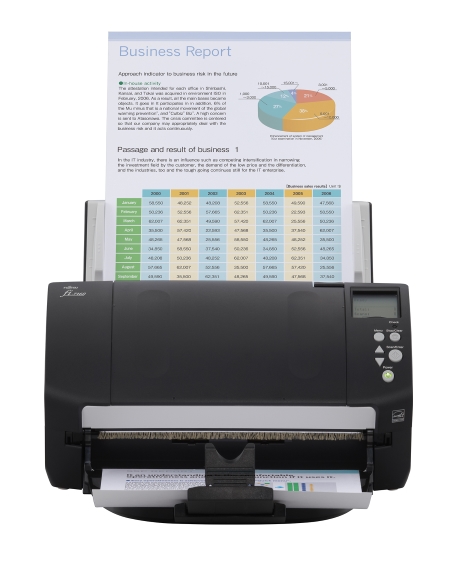
The fi-7160's distinction from the slower fi-7140 is not only the speed figure. PFU's Global page describes a backlit LCD for operation viewing, and the official exact-model image shows a physical button panel beside that display. The reviewed sources do not identify touchscreen profile selection, so the LCD should not be treated as a configurable touch panel. Its ADF-only form also leaves bound books and delicate originals to another device or route; it is not the same configuration as the platen-equipped fi-7260.
PFU lists USB and TWAIN/ISIS capture. The model-specific Global source specifies USB 3.0/2.0/1.1; PFU America's current exact U.S. model page says USB 3.2. Those statements differ on protocol generation. The common evidence is a USB-to-computer route, but anyone relying on a specific port revision should verify the physical unit and its exact cable. Do not treat this assessment as proof of Wi-Fi, Ethernet, phone capture or computer-free cloud delivery; none of those operating plans is documented in the inspected references.
Feeding safeguards still have limits
The Global page describes ultrasonic overlap detection and a paper-protection feature with sound detection, called iSOP. PFU America's page discusses sound and image monitoring. These are mechanisms intended to help detect feeding problems, not a promise that a double-feed, skew or paper jam cannot occur. Prepare batches carefully, keep critical originals until the output has been checked, and follow the maintenance and roller guidance for the exact unit. This is especially important when a record is difficult to replace or when missed sides would have legal or financial consequences.
The official Global specification lists TWAIN, TWAIN x64 and ISIS driver interfaces, plus other region-qualified drivers. A driver name alone does not establish that the current host, application, architecture and unit revision work together. PFU's PaperStream IP table current as of October 6, 2026 lists the fi-7160 in a discontinued group. That list is useful context, but it is not an operating-system guarantee. Confirm a supported driver package and a trial workflow before purchasing an earlier scanner for an organization that depends on a fixed capture application.
How to compare the related models
Against the fi-7140, the fi-7160 has the higher published rate (60/120 instead of 40/80), an LCD panel and sound detection in the Global paper-protection description; both are compact ADF-only machines with an 80-sheet nominal load. Against the fi-7260, it keeps the higher rate but gives up the built-in flatbed. The fi-7240 offers the glass platen at the lower 40/80 ADF rate. Those differences matter more to a real workflow than a model number alone: decide whether the work contains bound or fragile originals, and whether faster ADF capture or a platen has more value.
PFU's U.S. page says the fi-7160 was upgraded to the fi-8170. That successor statement does not make an older fi-7160 equivalent to the new model or establish exact package, connectivity or service terms for a seller's machine. This library classifies the fi-7160 as earlier and does not claim it is currently offered.
Buying checks for an earlier fi-7160
The model may fit a wired office that wants duplex stacks, a compact 80-sheet feeder, a higher manufacturer-rated speed than the fi-7140 and an LCD for status. It is a poor choice when a flatbed, touchscreen selection, wireless placement, mobile scanning or a documented current driver path is essential. The published figures are not independent performance measurements, and no customer experience or ownership claim is made.
Ask for a clear photo of the fi-7160 label and USB connection, confirm the exact unit's condition and included power/host cables, verify driver and application support on the intended computer, and check roller status and the seller's return terms. The U.S. discontinued roster's service language is not a transferable warranty promise. Confirm every accessory and service term in writing rather than inferring it from a product image or an old listing.
Key specifications
Key details at a glance
| Scanner class | Professional desktop sheet-fed scanner |
|---|---|
| Manufacturer-listed simplex rate | 60 ppm |
| Manufacturer-listed duplex image rate | 120 ipm |
| Automatic document feeder capacity | 80 sheets |
| Optical resolution | 600 dpi |
| Connection options | USB |
| Automatic duplex capture | Yes |
| TWAIN driver documented | Yes |
Use the exact model’s instructions for operating limits, supplied equipment and version differences.
Sources for this review
Sources for this assessment
- PFU America: exact U.S. fi-7160 model and driver page
- PFU America: U.S. discontinued scanner and service-status roster
- PFU/Ricoh Global: exact-model fi-7160 page
- PFU/Ricoh Global: exact-model fi-7160 datasheet
- PFU/Ricoh Global: PaperStream IP scanner table, current as of October 6, 2026
- PFU/Ricoh Global: exact-model fi-7160 official product image

Compare the workflow before you choose
Use the finder to test your connection, paper and software requirements against the documented scanner arrangements.