
Your needs, this model
Does it fit your priorities?
Can the fi-7260 handle a loose duplex stack and a book on the same machine?
The model includes a duplex ADF for loose sheets and a separate flatbed for a single original at a time. The glass limit is 8.5 × 11.7 inches; the 60 ppm/120 ipm rating applies to the ADF, not the flatbed, which is rated at 1.7 seconds per page at 200 dpi.
Explore this need in the finder →What separates the fi-7260 from the slower fi-7240?
Both combine an 80-sheet duplex ADF and a separate flatbed; the Global tables list an 8.5 × 11.7 inch platen maximum, while the fi-7260 U.S. page describes its flatbed as Letter-size. The fi-7260 is rated at 60 ppm/120 ipm rather than 40/80 and adds sound detection to the Global page's iSOP paper-protection description. PFU's stated 9,000-sheet daily estimate is planning guidance, not a tested duty guarantee.
Explore this need in the finder →Is USB 3.2 or a touchscreen guaranteed for the exact unit?
The U.S. model page labels USB 3.2, while the exact-model Global datasheet lists USB 3.0/2.0/1.1; the interface-generation conflict is not resolved. The Global page documents a backlit LCD and physical controls, not a touchscreen. Confirm the port, cable, driver and profile workflow on the exact machine before purchase.
Explore this need in the finder →Review basis: This is a source-led review of the exact U.S. fi-7260 model, not a hands-on test. PFU America's U.S. model page identifies the fi-7260 and its discontinued roster lists it as no longer for sale but still eligible for extended service. Those statements do not establish a live seller offer, condition, U.S. part number, package contents or transferable service for a particular unit.
Fast ADF batches plus a separate platen
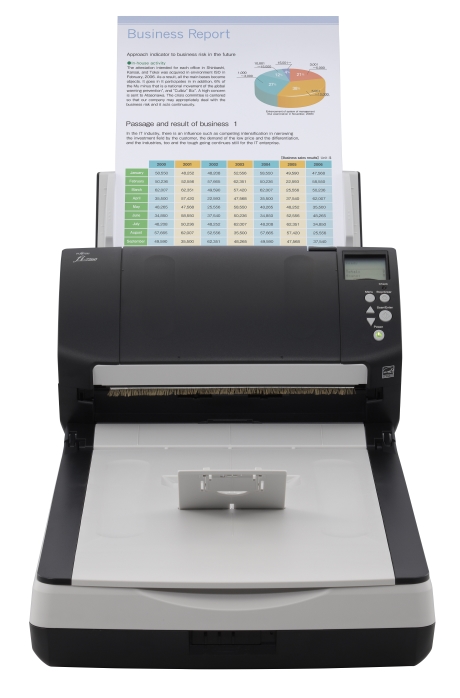
The fi-7260 combines an automatic document feeder with a built-in flatbed. PFU specifies an ADF rate of up to 60 pages per minute and 120 images per minute for A4 portrait at 200/300 dpi. It separately lists a flatbed scan time of 1.7 seconds per page at 200 dpi. The ADF's duplex rate is not a glass-scanning speed, and neither number measures a complete job with paper preparation, cleanup, OCR, transfer and filing.
That two-route layout can be valuable in an office that normally feeds loose, double-sided documents but occasionally needs to scan a bound page, photograph or fragile sheet on glass. The U.S. fi-7260 page calls the flatbed Letter-size; the Global exact-model table lists its maximum as 8.5 × 11.7 inches. Do not assume a large bound volume will fit or lie flat; the glass route handles originals individually, and the ADF's advertised speed applies only to its supported feed workflow.
Nominal ADF capacity is still 80 sheets
PFU rates the feeder at 80 sheets for A4 80 g/m² or Letter 20 lb originals. It warns that the maximum can vary with paper weight. The flatbed does not increase that stack capacity; it only offers another route for one original at a time. The Global datasheet lists a legal-size ADF maximum and separate ADF media limits, so confirm the exact paper size and stack conditions for your originals rather than assuming that every mixed load reaches 80.
The published ADF speed is 60 ppm/120 ipm, and PFU gives an expected daily volume of 9,000 sheets based on its rate and typical scanner-use hours. Neither is an independent test or a promise of unit life. The figure does not account for jam recovery, glass cleaning, exception handling, image correction or operator review. A team deciding between the fi-7260 and an ADF-only 100-sheet model should weigh the value of the platen against the operational value of a larger one-load feeder.
LCD status and feeding-protection notes
The exact Global page describes a backlit LCD for operation viewing and sound detection as part of iSOP paper protection. The official fi-7260 image shows the LCD and physical buttons. The reviewed product references do not identify a touchscreen, so the screen should not be presented as a touch-selected profile interface. PFU America's U.S. page describes sound and image monitoring. These mechanisms are intended to detect or reduce feeding problems; they cannot make every double-feed, skew or jam impossible.
PFU documents integrated TWAIN and ISIS capture interfaces, useful for software that names those requirements. But driver availability, the exact host OS, application version, architecture and scanner revision still need checking. The PaperStream IP table current as of October 6, 2026 places fi-7260 in its discontinued group. That supports caution about age and support verification, not a claim that a particular software version works or fails. Confirm the intended workflow with the specific unit before a department depends on it.
Connection details remain an unresolved check
The reviewed U.S. product page labels the fi-7260 as USB 3.2, while the exact-model Global datasheet lists USB 3.0/2.0/1.1. Both sources support USB-connected computer capture, but their protocol-generation descriptions do not match. This review does not choose one over the other. If an older host or cable is part of the plan, inspect the port on the actual machine and check the exact U.S. documentation or ask the manufacturer for clarification. The inspected sources do not establish Wi-Fi, mobile capture, Ethernet or scanner-direct cloud delivery for this model.
Compare its role with the other fi-7x60 models
The fi-7260 is the faster of the two combo variants in this group: it shares an 80-sheet duplex ADF with the fi-7240, but is rated at 60/120 rather than 40/80 and has the LCD/sound-detection details in the Global material. Both have a separate platen with a Global-listed maximum of 8.5 × 11.7 inches; the U.S. fi-7260 page calls its flatbed Letter-size. The fi-7160 offers the higher 60/120 rate and LCD in a more compact ADF-only body. The fi-7140 is also ADF-only and is rated at 40/80.
PFU says the fi-7260 was replaced by the fi-8270. That successor note is not a promise of one-to-one feature parity. Confirm the exact machine and package rather than using a replacement name to identify an old listing. The U.S. discontinued roster's service language also does not guarantee coverage to a future purchaser or resolve any reseller's terms.
Buying checks for the fi-7260
This model may suit a USB workstation that needs duplex ADF batches, an 80-sheet rated load and a glass path for bound or fragile originals. It is a weaker fit if the work depends on Wi-Fi, mobile capture, touch-screen profile choice, a distinct Manual Feed mode, a larger platen or a feeder above 80 sheets. It also occupies more desk depth than the ADF-only variants; allow room to open the flatbed lid and retrieve loaded pages.
Ask the seller for a photo of the unit's exact model and port, check the platen and ADF mechanism, confirm the driver and target application on the intended host, and verify the included power and USB accessories. Review roller condition, return terms and any service offer separately. No current price, inventory status or independent performance result is asserted here. Manufacturer ratings help frame the comparison; they cannot replace a condition and compatibility check on the exact unit.
Key specifications
Key details at a glance
| Scanner class | Professional desktop flatbed adf |
|---|---|
| Manufacturer-listed simplex rate | 60 ppm |
| Manufacturer-listed duplex image rate | 120 ipm |
| Automatic document feeder capacity | 80 sheets |
| Optical resolution | 600 dpi |
| Connection options | USB |
| Automatic duplex capture | Yes |
| TWAIN driver documented | Yes |
Use the exact model’s instructions for operating limits, supplied equipment and version differences.
Sources for this review
Sources for this assessment
- PFU America: exact U.S. fi-7260 model and driver page
- PFU America: U.S. discontinued scanner and service-status roster
- PFU/Ricoh Global: exact-model fi-7260 page
- PFU/Ricoh Global: exact-model fi-7260 datasheet
- PFU/Ricoh Global: PaperStream IP scanner table, current as of October 6, 2026
- PFU/Ricoh Global: exact-model fi-7260 official product image

Compare the workflow before you choose
Use the finder to test your connection, paper and software requirements against the documented scanner arrangements.