
Your needs, this model
Does it fit your priorities?
What kind of original belongs on the fi-7280 glass instead of the feeder?
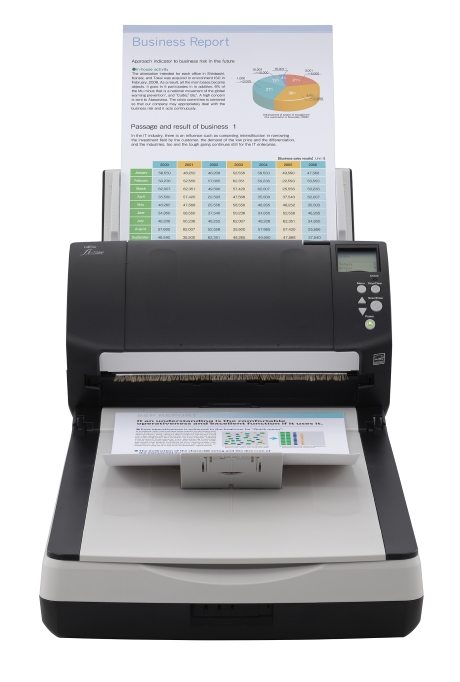
The fi-7280 has both a duplex ADF for loose stacks and a separate flatbed whose maximum area is 8.5 × 11.7 inches. Use the glass for one suitable original at a time, such as a bound page or fragile sheet that should not travel through the feeder. The glass is not a letter-plus-legal platen and the ADF rate does not describe platen speed; PFU specifies 1.7 seconds per flatbed page at 200 dpi.
Explore this need in the finder →Does the flatbed model feed faster than the fi-7180?
No higher ADF rate is documented. Both exact Global model tables list the fi-7180 and fi-7280 at 80 ppm simplex/160 ipm duplex, with an 80-sheet ADF on the specified stock basis. The fi-7280 adds the glass path and weighs 19.4 lb with a 22.7-inch body depth; the fi-7180 is the compact 9.3-lb ADF-only alternative. Treat the published rate as a manufacturer specification, not an observed job time.
Explore this need in the finder →Can the fi-7280 feed unusual pages one at a time as well as use the flatbed?
Yes, the shared fi-7x80 manual documents one-sheet-at-a-time manual feeding into the ADF after enabling a panel/software timeout. That is different from setting one page on the glass. It can help when checking each sheet or separating originals that are poor candidates for one batch, but frequent manual feed may shorten consumable intervals. Check the exact card or media instructions and current software support before relying on it.
Explore this need in the finder →The Ricoh fi-7280 is an earlier departmental document scanner with two separate ways to capture originals: a duplex automatic document feeder for loose stacks and a built-in flatbed for one page at a time. Its ADF is rated at 80 pages per minute simplex or 160 images per minute duplex at A4 portrait, 200/300 dpi. PFU lists a separate flatbed rate of 1.7 seconds per page at 200 dpi. This is a specification-led assessment rather than a hands-on test; the rated figure is not a measured time for a finished, OCR-processed office job.
Choose it when the glass matters
The fi-7280's practical distinction from the fi-7180 is not a faster feeder. Both have the same published 80/160 ADF tier and an 80-sheet loading rating; the 7280 adds a glass platen. PFU's exact Global specification gives the flatbed a maximum document area of 8.5 × 11.7 inches. That makes it a useful second path for one suitable bound, fragile, rigid or single original that should not be sent through the ADF. It is not a legal-size platen, and the flatbed's 1.7-second rate should not be confused with ADF pages-per-minute figures.
The addition changes the physical setup substantially. PFU lists the fi-7280 at 11.8 × 22.7 × 9.2 inches and 19.4 pounds, excluding feeder chute and stacker. The fi-7180 is the lighter ADF-only chassis at 11.8 × 6.7 × 6.4 inches and 9.3 pounds. If you routinely need glass scanning, those extra dimensions buy a real route the 7180 lacks; if your work is only loose paper, the 7280's size and weight are difficult to justify from the feeder rate alone.
The 80-sheet rating still has a paper basis
The 80-sheet ADF capacity is stated for A4 80 g/m² or Letter 20 lb paper. The shared Operator's Guide says the loaded stack should remain under 8 mm and the maximum varies with paper. Do not count the glass as additional feeder capacity, and do not assume 80 sheets for heavier stock, mixed sizes or every special original. The technical tables list a maximum ADF size of 8.5 × 14 inches; the flatbed limit is the separate 8.5 × 11.7-inch glass area.
PFU also gives an expected daily volume of 11,000 sheets. That is a manufacturer planning figure based on scanning speed and typical usage, not a guarantee of output or unit durability. Ultrasonic multifeed detection, skew reduction and sound-based paper protection are useful design features, but they do not promise that every double-feed, jam or fragile-page risk disappears. The exact model manual and the condition of an earlier unit matter more than broad claims about unattended volume.
Manual feed and card handling are distinct choices
The fi-7280 also supports a documented one-sheet-at-a-time manual-feed mode within the ADF. An operator enables a timeout in the panel or Software Operation Panel, feeds one page, and loads the next while the scanner waits. The manual describes this for checking pages individually and separating originals that are difficult to scan together. It is not another paper tray, nor is it the same as placing one sheet on the glass. PFU warns that using manual feed frequently can shorten consumable intervals.
Thick plastic cards use another model-specific setting with orientation and resolution restrictions. A general claim that the scanner accepts one card does not establish every card thickness, embossed surface, mixed batch or workflow. Use the Operator's Guide for the exact original, and check whether the installed software exposes the required setting.
Connection and software deserve an installation check
The U.S. page documents USB and integrated TWAIN/ISIS connectivity. Its USB 3.2 label differs from the exact Global page and datasheet, which list USB 3.0/2.0/1.1; this assessment uses generic USB only. Before purchase, confirm the actual unit's port and cable, then verify the host computer and capture program. A driver name in a specification is not proof that every current application will recognize an older scanner.
PFU's compatibility FAQ, updated October 2026, lists fi-7280 in its Windows and Linux supported-model groups, but marks the grouped fi-7240/fi-7260/fi-7280 row not applicable in the current macOS table. It also excludes Windows on ARM and warns that legacy applications may not be bundled and their download service has ended. That makes a Windows or Linux route more plausible from the cited current matrix than an assumed Mac installation, but the particular OS, architecture, driver build and install media still need to be checked.
Earlier status makes the exact unit decisive
PFU marks the fi-7280 discontinued and says it was replaced by fi-8290. The U.S. discontinued roster says its listed models are no longer available for sale but remain eligible for extended service. Neither statement proves that a particular reseller has stock, that a used scanner is functional, or that coverage transfers to the buyer. For a used or refurbished unit, verify the model label, ADF rollers, platen glass, included power and USB items, seller condition, return terms, current software route and any proposed support entitlement. This assessment does not infer a part number, package, price or current offer.
The fi-7280 is the more versatile choice only when the combination of an 80-sheet duplex feeder and a genuine flatbed solves a mixed-original workflow. It shares the fi-7180's feeder speed rather than exceeding it, and its macOS status is materially different in PFU's current matrix. If a platen is unnecessary, the smaller fi-7180 is the more compact comparable model; if a current software path, lighter chassis or new-machine terms are essential, compare current models rather than assuming this discontinued scanner will meet them. The assessment uses PFU America's exact U.S. page and lifecycle roster, the Global exact-model specifications and datasheet, the shared Operator's Guide and PFU's dated OS FAQ; it reports no personal use or independent testing.
PFU America fi-7280 page · PFU/Ricoh Global fi-7280 specifications · PFU/Ricoh Global fi-7180 specifications · PFU fi-series OS compatibility FAQ.
Key specifications
Key details at a glance
| Scanner class | Professional desktop flatbed adf |
|---|---|
| Manufacturer-listed simplex rate | 80 ppm |
| Manufacturer-listed duplex image rate | 160 ipm |
| Automatic document feeder capacity | 80 sheets |
| Optical resolution | 600 dpi |
| Connection options | USB |
| Automatic duplex capture | Yes |
| Separate manual-feed route | Yes |
| TWAIN driver documented | Yes |
Use the exact model’s instructions for operating limits, supplied equipment and version differences.
Sources for this review
Sources for this assessment
- PFU America: exact U.S. fi-7280 model and driver page
- PFU America: U.S. discontinued scanner and service-status roster
- PFU/Ricoh Global: exact-model fi-7280 product and specifications page
- PFU/Ricoh Global: exact-model fi-7280 datasheet, 2022 edition
- PFU/Ricoh Global: fi-7180/fi-7280 Operator's Guide
- PFU/Ricoh: fi-7140/fi-7160/fi-7180/fi-7240/fi-7260/fi-7280 OS and software compatibility FAQ
- PFU/Ricoh Global: exact-model fi-7280 product photograph

Compare the workflow before you choose
Use the finder to test your connection, paper and software requirements against the documented scanner arrangements.