
Your needs, this model
Does it fit your priorities?
Can it alternate between short office batches and special originals such as passports?
PFU documents a 20-sheet duplex U-turn ADF and a separate Return Scan path for supported special originals. The path and media limits differ; confirm the exact original against the current manual.
Explore this need in the finder →Is the fi-800R a large-network feeder?
No such route or capacity is established by the reviewed sources. The exact base model has a 20-sheet ADF and USB computer connection; no Ethernet, Wi-Fi or direct cloud destination is established.
Explore this need in the finder →Does the Premium offer change the scanner paths?
The Premium part CG01000-310322 is described as the same fi-800R scanner hardware with a five-year Advance Exchange service package. The different offer is a service-duration package, not a larger feeder or new connection route.
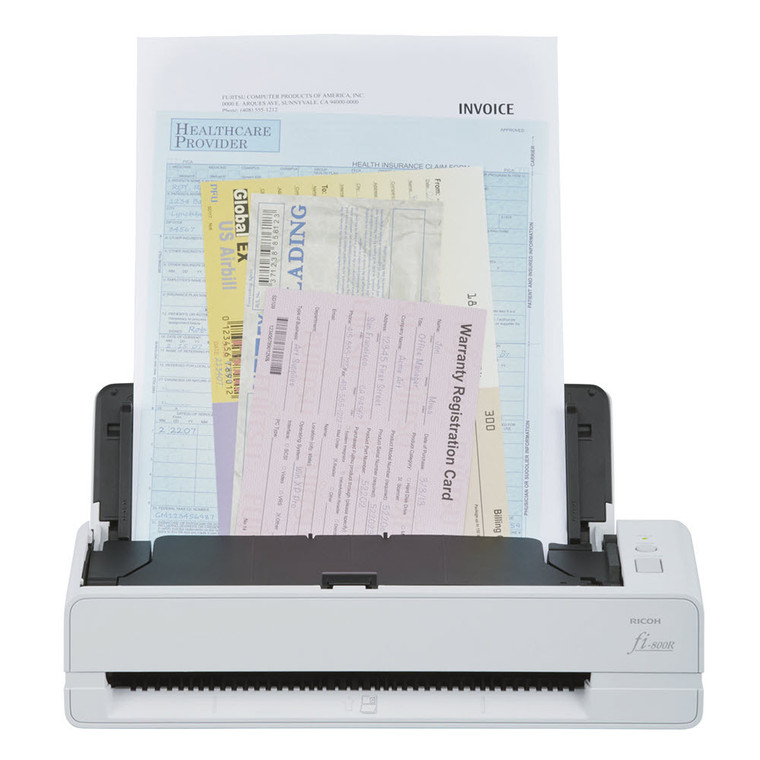
Explore this need in the finder →The fi-800R is a compact, wired document scanner built around two paper paths rather than a large general-purpose ADF. Its US base part is PA03795-B005. The separate Premium offer, CG01000-310322, packages the same scanner hardware with a five-year Advance Exchange service offer. This review compares the documented configurations and handling routes; it does not claim hands-on feeding, speed or reliability testing.
Two paths address different originals
For ordinary batches, the fi-800R uses a U-turn ADF rated for up to 20 sheets and a manufacturer maximum of 40 pages per minute or 80 images per minute in duplex at stated settings. It is not a 50- or 100-sheet workgroup feeder. The smaller capacity makes more sense when a counter, reception desk or compact work area handles shorter batches and available desk space matters.
Its other route is Return Scan: a special original travels through a front path and returns toward the operator instead of following a conventional output-tray routine. PFU describes this for items such as passports, cards and booklets up to a stated thickness of 5 mm without a carrier sheet, within the manual’s limitations. The separate path is useful precisely because a fragile or bound original is not just another sheet for the U-turn stack. Check the current guide for exact sizes, thickness restrictions and placement before using unusual media.
The two routes make the model easier to reason about but do not make it a flatbed. A bound document or a delicate original that needs a stationary glass platen requires another solution. Nor should the 5 mm Return Scan figure be read as permission to pass every object of that thickness through the ADF or any other path.
It is a USB-to-computer workflow
PFU’s US specifications establish USB connectivity for the fi-800R and list TWAIN, TWAIN x64, ISIS and WIA-related software support. The reviewed product sources do not establish Ethernet, Wi-Fi, a mobile-device route or a computer-free cloud destination. If a shared reception team needs a network drop-off station, do not infer one from the scanner’s compact form or from another fi-series model. Confirm the exact host and capture application before purchase.
Its control panel is intended for operating the scanner, but the reviewed pages do not establish a touchscreen workflow for browsing jobs. Treat profile selection and destination management as a host/software question unless the precise configuration documentation says otherwise. This is a practical distinction from networked machines that put prepared destinations on a large panel.
Compactness does not remove preparation
The manufacturer presents the dual-path design as space-saving and describes output behavior that does not rely on a conventional large exit tray for the U-turn path. A compact body can help when counter depth is limited, but the operator still needs clearance to feed originals and retrieve returned documents. For a heavy mixed stack, prepare pages, remove clips and staples, separate special media, and follow the manual rather than treating the scanner as a miniature high-volume feeder.
The rated 40 ppm/80 ipm is a maximum specification under stated settings, not a measured office throughput. A short passport-to-case-management task may be governed more by opening the record, naming a file, checking the result and returning the original than by scan speed. No independent tests of image quality, feed reliability, OCR or job time were conducted for this review.
What the Premium bundle changes
The base offer is PA03795-B005. PFU’s Premium bundle part CG01000-310322 describes the same fi-800R hardware with five-year Advance Exchange service, while the base product page describes a three-year service package. The extended coverage is the material difference; the listed feeder size, dual paths and interfaces remain those of the fi-800R. Confirm the coverage period, exclusions, activation, shipping and eligibility in the actual offer before treating the package as a service commitment.
Compare it with the fi-8150 if the daily work is mostly ordinary batch scanning: that machine has a 100-sheet feeder and wired Ethernet but takes more room and uses a different workflow. The fi-8040 is another wired model, but its 50-sheet feeder, touchscreen and DirectScan destination route target a networked station. The fi-800R stands apart when operator proximity and a special return path for passports or other originals matter more than large batch capacity or network deployment.
Check the driver and service details
PFU’s 2026 driver notice says fi-800R units manufactured on or after April 1, 2026 use changed identification that PaperStream IP 3.36.0 and earlier will not recognize; PFU recommends 3.40.1 or later. The warning is conditional on production date, so ask which unit you are buying if the host environment is tightly controlled. Also verify operating-system support, the desired TWAIN/ISIS application, the exact package part, current paper limits, and whether the Premium service term fits the organization’s coverage requirements.
For an individual desk with a high-volume 100-sheet expectation, Wi-Fi requirement, flatbed originals or network-only routing, another configuration is likely a better starting point. For a compact counter that regularly switches between short duplex batches and individual special originals, the fi-800R’s clearly separate paths make its purpose easier to identify. These are research-led fit boundaries, not a claim that a particular user or office will achieve a certain result.
Key specifications
Key details at a glance
| Scanner class | Compact professional desktop |
|---|---|
| Manufacturer-listed simplex rate | 40 ppm |
| Manufacturer-listed duplex image rate | 80 ipm |
| Automatic document feeder capacity | 20 sheets |
| Optical resolution | 600 dpi |
| Connection options | USB |
| Automatic duplex capture | Yes |
| Separate manual-feed route | Yes |
| TWAIN driver documented | Yes |
Use the exact model’s instructions for operating limits, supplied equipment and version differences.
Sources for this review
Sources for this assessment
Compare the workflow before you choose
Use the finder to test your connection, paper and software requirements against the documented scanner arrangements.