
Your needs, this model
Does it fit your priorities?
Does the fi-8270 handle both prepared stacks and originals that should not enter an ADF?
Yes, the exact base model combines a 100-sheet duplex ADF with a separate letter-size flatbed. Use the correct path for each original and consult the manual for its media limits.
Explore this need in the finder →Is it the same machine as the flatbed-free fi-8170?
No. The fi-8270 base part PA03810-B555 includes a letter-size flatbed as well as an ADF; the fi-8170 base offer is a sheet-fed model. Similar rated ADF speeds do not make the originals-handling routes identical.
Explore this need in the finder →Should the published 10,000-sheet daily volume be treated as a durability guarantee?
No. PFU calls the expected daily-volume figure a calculated reference rather than a guarantee of daily output or durability. Validate the real duty cycle, media mix and service requirements with the current documentation.
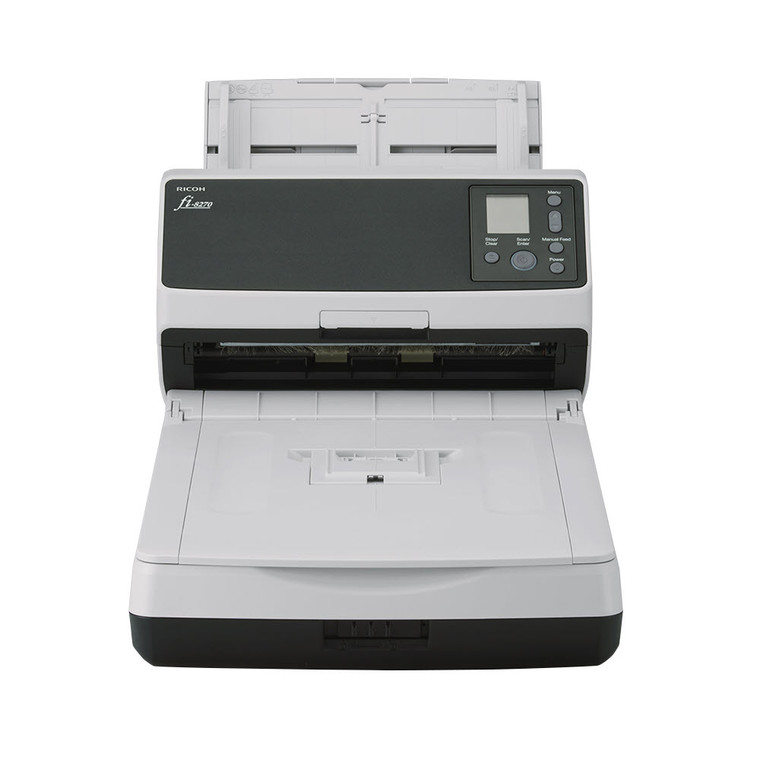
Explore this need in the finder →The fi-8270 is a duplex ADF scanner with a separate letter-size flatbed, not just a faster sheet-fed fi-8170. This review covers PFU’s US base offer PA03810-B555. The flatbed adds a different way to capture books, fragile pages and one-off originals, while the ADF remains available for prepared stacks. The discussion is based on official PFU product, datasheet and operator-guide sources. No measured speed, image quality or long-run performance is claimed.
The flatbed changes what the scanner can handle
PFU rates the fi-8270’s ADF at up to 70 pages per minute or 140 images per minute at 200/300 dpi and lists a 100-sheet feeder. The separate flatbed is rated at 1.7 seconds per letter-size page under published conditions. These are manufacturer specifications rather than observed job results. The ADF is for supported, prepared sheets; the flatbed is the stationary surface for originals that should not travel through rollers or that need to be captured one page at a time.
That distinction matters more than comparing two similar ppm figures. A flatbed can accommodate a bound volume or delicate sheet that is not suitable for an ADF, but it is inherently a page-by-page route. The fi-8170 has a similarly high-speed ADF and manual-feed option but no flatbed established in its reviewed base offer. The fi-8270 adds the glass platen without abandoning duplex batches, making it a plausible office choice when a department has both kinds of originals.
Wired computer workflows and manual feed
The datasheet lists USB and 10/100/1000 Ethernet, duplex capture, TWAIN/TWAIN x64 and ISIS drivers. The control panel is described as an LCD and buttons rather than a touchscreen. PFU also documents a manual-feed route for certain special originals. The ADF, flatbed and manual-feed workflows should remain conceptually separate: a flatbed original is positioned on glass, a stack uses the ADF within its limits, and special media follow the manual’s specified path.
No Wi-Fi, mobile-device workflow or direct cloud destination is established in the reviewed sources. A wired Ethernet port is useful for a networked computer or managed capture setup, but does not prove that the scanner can deliver directly to a cloud account without a host. Confirm the required application, driver, OS and server arrangement before purchase, especially if this machine will replace an established fleet scanner.
Use the ratings as planning inputs
PFU lists a 10,000-sheet expected daily volume, while its specification text says these values are calculated reference figures and not a guarantee of daily output or product durability. Likewise, the advertised ADF and flatbed times do not include every workflow step. A realistic estimate should include batch preparation, the number of flatbed pages, OCR, review, exception handling, file naming and destination checks. If service levels depend on a measured cycle time, obtain a demonstration under representative conditions rather than treating a data-sheet maximum as a promise.
The datasheet lists long-page, card and booklet support within specific limits. Because different originals use different routes and restrictions, check the current manual for the exact size, thickness, paper-weight and feed requirements. Do not assume the feeder can handle an original simply because the scanner also has a flatbed or a manual-feed mode.
Drivers and manufacture date
PFU’s 2026 driver notice says fi-8270 units manufactured on or after April 1, 2026 use updated identification that PaperStream IP 3.36.0 and earlier do not recognize; PFU recommends version 3.40.1 or later. The condition is tied to production date. If procurement must work with a frozen driver image, ask the seller to identify the unit’s manufacture date and confirm the supported driver route before rollout.
The base offer lists a one-year Advance Exchange service term. Confirm that the chosen seller and exact part preserve the service terms you expect, and check any extended service package separately. A scanner may be technically compatible but still be an awkward fit if the organization cannot support its driver update, feeder maintenance, destination software or flatbed operator process.
Who benefits from the hybrid design?
The fi-8270 is a plausible shortlist option for a wired workgroup that regularly captures both prepared duplex batches and occasional book, fragile or single-sheet originals. It keeps a 100-sheet ADF for the stack workflow, then supplies a separate platen for originals that should not be fed. A small personal desk that never scans bound or delicate pages may not need that extra mechanism. A phone-first user or a team that requires wireless capture should start with a product whose exact sources establish those routes.
Before buying, verify the US part PA03810-B555, software and host compatibility, the driver notice for the manufacture date, the current paper limits and the included service term. The fi-8170 is the closer comparison if an ADF-only machine is sufficient; the fi-8270 is not simply that model with a different panel. No hands-on test, user experience, current price or stock claim is made. The important decision is whether the flatbed is a regular enough part of the workflow to justify a larger, more involved desktop device.
Key specifications
Key details at a glance
| Scanner class | Professional desktop adf flatbed |
|---|---|
| Manufacturer-listed simplex rate | 70 ppm |
| Manufacturer-listed duplex image rate | 140 ipm |
| Automatic document feeder capacity | 100 sheets |
| Optical resolution | 600 dpi |
| Connection options | USB / Ethernet |
| Automatic duplex capture | Yes |
| Separate manual-feed route | Yes |
| Touchscreen | No |
| TWAIN driver documented | Yes |
Use the exact model’s instructions for operating limits, supplied equipment and version differences.
Sources for this review
Sources for this assessment
Compare the workflow before you choose
Use the finder to test your connection, paper and software requirements against the documented scanner arrangements.