
Your needs, this model
Does it fit your priorities?
What does the fi-8700's 300-sheet ADF figure actually cover?
PFU's U.S. datasheet qualifies the 300-sheet maximum to A4/Letter paper at 20 lb / 80 g/m² and says capacity depends on document thickness. PFU Japan's same-model technical table separately gives 100 A3 sheets at 80 g/m². The 44,000-sheet Expected Daily Volume is a manufacturer planning estimate, not a one-load capacity, guaranteed throughput or durability promise. Check the local feed instructions for the exact stock and batch.
Explore this need in the finder →When should an original go on the fi-8700 flatbed rather than in its ADF?
PFU lists a 12-by-17-inch ADF maximum and an integrated 12-by-18-inch flatbed. The flatbed is the separate route for supported bound, fragile, bulky or oversized items that should not be fed loose through the automatic path; it does not increase ADF sheet capacity. Check the current instructions for an object's size, thickness and handling limits before scanning it.
Explore this need in the finder →Does the fi-8700 offer a manual-feed mode and a touchscreen?
PFU Japan's exact fi-8700 specification lists ADF, manual-feed/single-sheet and flatbed routes, so a separate one-at-a-time mode is documented for the model. The inspected U.S. page/datasheet does not give its procedure or media limits; confirm those in the local operator's guide. The U.S. sources describe a color LCD, not touch input, so touchscreen profile selection is not established.
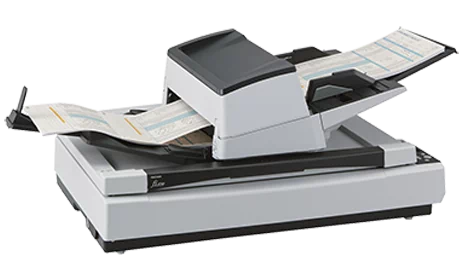
Explore this need in the finder →The fi-8700 pairs a large duplex automatic document feeder with an integrated flatbed, so it can handle a stack of office pages and keep a second capture surface available for supported bound or awkward originals. This is a source-based assessment of PFU's U.S. product page and specification sheet, with regional fi-8700 information used only where stated. It is not a hands-on test, and rated speed is not a promise about a complete filing job.
Two capture routes, with different limits
The ADF accepts originals up to 12 by 17 inches; the separate flatbed reaches 12 by 18 inches. That extra glass area matters for books, fragile pages and other items that should not be fed as loose sheets, but it does not turn the platen into more feeder capacity. PFU also promotes Open-Cover Scanning, Timer Scan and Multi-Crop on the flatbed. Multi-Crop is intended to capture multiple separate items in one pass and save them individually; Timer Scan can help with repeated pages on the glass. These features do not automate page turning or make every bound object safe to scan.
Capacity depends on the paper being loaded
PFU's U.S. datasheet rates the feeder for up to 300 A4/Letter sheets at 20 lb (80 g/m²), and notes that capacity varies with document thickness. PFU Japan's exact fi-8700 technical table gives a separate 100-sheet A3 basis at 80 g/m². Read those as size-qualified load limits, not as 300 sheets of every format or mixed stock. The feeder's largest listed original is 12 by 17 inches; large paper and heavier stock need their own loading guidance.
The U.S. sheet also lists long-page capture up to 220 inches when set at 200 dpi or below. A split-page mode is described for longer originals, but the exact local procedure and connection requirements should be checked in the operator's guide before relying on it. PFU's 44,000-sheet Expected Daily Volume is a manufacturer estimate, not a guaranteed daily output or a durability test.
Rated pace is only one part of throughput
The published maximum is 100 pages per minute simplex or 200 images per minute duplex. PFU's global release qualifies those peak figures for A4 landscape, color at 200 or 300 dpi; a portrait batch, higher-resolution job, different compression or a slower host can change results. Loading, file naming, OCR, transfer and exception handling also affect a real job. This is not an independently measured estimate of how long your records will take.
PFU lists ultrasonic overlap detection, document-length and lag detection, plus Intelligent Sonic Paper Protection. Those are useful safeguards for mixed work, not a guarantee against a missed overlap, damaged original or jam. The U.S. datasheet lists card stock up to 1.4 mm thick; the regional technical page distinguishes non-embossed cards from embossed cards. For cards, attached notes, taped receipts or unusual stock, check the current local guide and use a batch size suited to the actual materials.
Manual feed is separate from both the stack and the glass
PFU Japan's exact fi-8700 specification identifies an ADF, manual-feed/single-sheet route and flatbed. That supports a separate one-at-a-time feed mode at the model level. U.S. instructions and media limits remain unverified; consult the local guide before using it for special originals. Manual feed is not another bulk tray, and it should not be confused with placing an item on the flatbed.
Choose a wired host, not an assumed wireless workflow
PFU lists USB Type-B and wired Ethernet, including Gigabit Ethernet, and the U.S. datasheet identifies TWAIN, TWAIN x64 and ISIS support. The U.S. interface list does not include Wi-Fi, and the inspected sources do not establish mobile-device scanning or computer-free cloud delivery. A color LCD is described, but touch input is not established, so this assessment does not count it as a touchscreen model.
The datasheet lists Windows 10 and 11 plus several Windows Server releases; it does not establish every current OS build, host architecture or third-party application's compatibility. The setup sheet also names PaperStream IP, Capture, ClickScan and administration tools, but a listed software family is not proof that a particular seller includes the needed media, subscription, version or license. Confirm those details with the offer and software owner before deployment.
Size, service and package terms need a written check
The scanner body is listed at about 27.8 by 19.7 by 13.6 inches and 77 pounds. Those dimensions do not supply an installation-clearance measurement; plan space for loading, output and access to a full-size production chassis. The U.S. datasheet lists three months of Basic Onsite for the base page; confirm seller eligibility and service start.
There is also a specifically named package row, PaperStream Capture Pro Premium Bundle CG01000-399231. The same U.S. datasheet's brief description says it is a fi-8700 with one-year ScanCare service. Because the package name and short description do not clearly enumerate a separate software entitlement or the complete service conditions, obtain the full written contents and terms rather than inferring them from the title. Keep this package distinct from the standalone product-page configuration. PFU's U.S. page offers a demo request and does not identify a standard base SKU, current quote, stock or seller carton; verify the exact part, included accessories, software and service before purchasing.
Who should shortlist the fi-8700?
It is worth evaluating for a document-heavy operation that needs both a high-capacity duplex ADF and a large flatbed on the same machine, with USB or wired Ethernet host capture. It is a poor fit for a portable desk-side routine, an essential wireless/mobile route, or a workflow that requires a confirmed touchscreen. Before choosing it, check your real paper sizes and weights, workspace, host and driver, manual-feed instructions, seller package and service terms against the current local documentation.
Sources: PFU America fi-8700 product page; PFU America U.S. fi-8700 datasheet; PFU Global fi-8700 launch details; PFU Japan fi-8700 / fi-8700S specifications.
Key specifications
Key details at a glance
| Scanner class | Professional production flatbed adf |
|---|---|
| Manufacturer-listed simplex rate | 100 ppm |
| Manufacturer-listed duplex image rate | 200 ipm |
| Automatic document feeder capacity | 300 sheets |
| Optical resolution | 600 dpi |
| Connection options | USB / Ethernet |
| Automatic duplex capture | Yes |
| Separate manual-feed route | Yes |
| TWAIN driver documented | Yes |
Use the exact model’s instructions for operating limits, supplied equipment and version differences.
Sources for this review
Sources for this assessment
- PFU America current unfiltered U.S. all-scanners list: fi-8700 card
- PFU America: Ricoh fi-8700 - Large Format Flatbed Scanner
- PFU America: 20261021_Datasheet_fi8700
- PFU Global: New RICOH fi-8700 Series and fi-8600 A3 Scanners for High-Volume Document Digitization
- PFU Japan: A3高速イメージスキャナー fi-8700/fi-8700S 仕様詳細
Compare the workflow before you choose
Use the finder to test your connection, paper and software requirements against the documented scanner arrangements.