
Your needs, this model
Does it fit your priorities?
Will a 50-sheet load work for any paper weight?
No. PFU rates the SP-1120 ADF at 50 sheets for A4 80 g/m² or Letter 20 lb; the manual also limits stack height to 5 mm or less. Heavier or mixed originals can require a smaller load, and a 60-sheet minimum is above its documented capacity.
Explore this need in the finder →Is the non-N SP-1120 a network scanner like SP-1120N?
No wired Ethernet is listed for the non-N model. PFU's comparison identifies USB 2.0/1.1 for SP-1120 and Ethernet for the N suffix. Do not treat “SP-1120” and “SP-1120N” as interchangeable names when checking a used listing.
Explore this need in the finder →Does the 20 ppm / 40 ipm claim predict how quickly a batch will finish?
It is PFU's A4-portrait manufacturer rate at 200/300 dpi, not an observed workflow result. Sorting, page condition, image processing, application setup and file transfer all affect total time; PFU's separate 3,000-sheet expected daily-volume figure is not a durability promise.
Explore this need in the finder →Review basis: This assessment concerns the earlier non-N SP-1120 model named on PFU America's U.S. discontinued roster, not the SP-1120N. PFU says rostered models are no longer available for sale but eligible for extended service; that is not a current stock statement or a guarantee that a used machine qualifies. The technical tables are exact Global SP-1120 references. No U.S. part number, reseller condition, current offer or carton contents was established.
A modest duplex feeder for a USB workstation
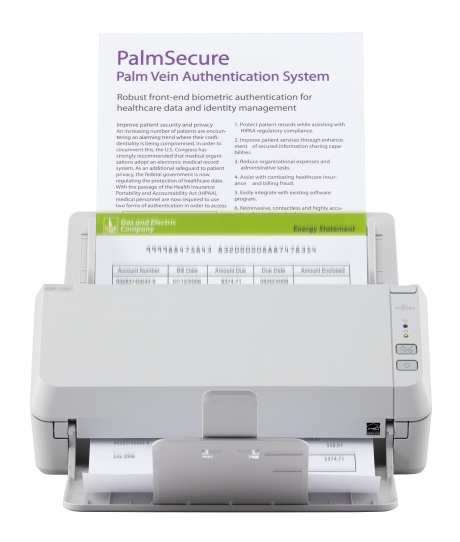
The SP-1120 is a sheet-fed duplex scanner with a manufacturer-rated 20 pages per minute simplex and 40 images per minute duplex for A4 portrait originals at 200/300 dpi. It can capture both sides in a pass, which is more useful for routine double-sided forms than a simplex flatbed that requires a separate flip. The stated speed is a specification, not a measured batch result; paper sorting, driver choices, image cleanup, recognition and saving add time. PFU separately lists 3,000 sheets as expected daily volume and explicitly cautions that such figures do not guarantee daily output or unit durability.
The ADF is listed for up to 50 sheets when loaded with A4 80 g/m² or Letter 20 lb paper. The shared manual's 5 mm stack limit is another condition to respect. A heavier, mixed, curled or unusually stiff stack may require less than the headline count. At its best-supported boundary, it meets a 50-sheet minimum; it cannot satisfy a 60-sheet minimum. That distinction matters if “50 sheets” describes a realistic maximum load rather than a promise of unattended throughput for every stock.
Do not confuse the no-N model with the networked suffix
The suffix distinction is substantive. PFU's comparison states that SP-1120N has wired Ethernet, while SP-1120 does not; the older non-N model uses USB 2.0/1.1. The exact non-N model is not a Wi-Fi device either. If a listing says “SP-1120,” inspect the label and rear ports rather than relying on a shortened seller title. The N, Ne, and no-suffix names are separate assessments in this library because connections and other included software differ.
The documented plan for this model is a USB-connected computer running a compatible scanner driver and capture program. PFU's references list TWAIN and ISIS, with TWAIN x64 and WIA also named in the technical material. A driver standard is only one part of compatibility: verify the host operating system, architecture, application version and driver download for the actual used unit. Do not assume a historical setup DVD contains a current installer or that a new computer will discover the scanner automatically.
Paper handling is more than the 50-sheet number
PFU lists a 600-dpi optical resolution, maximum page width of 8.5 inches and length of 14 inches for ordinary supported documents. The Global technical table gives paper weight from 50 to 209 g/m² and plastic-card thickness up to 0.76 mm, while the manual's instructions should control the exact loading and card procedure. Ultrasonic overlap detection is included in the model documentation, but that does not guarantee every receipt, taped form or card will feed without supervision. Older rollers and separation parts also make condition a practical question that a model specification cannot answer.
There is no separate glass platen in this configuration, and the reviewed materials do not establish a dedicated Manual Feed or bypass route. Do not choose it for originals that need flatbed capture or for a required special-media path unless a seller can document the exact configuration and manual. Likewise, a manual's statement that cards or varied media are supported does not turn into a touchscreen profile menu: the shared operator guide describes Scan/Stop and Power On/Off physical buttons.
The practical choice between SP-1120 and SP-1130
The SP-1130 uses the same 50-sheet rated capacity and non-N USB-only family, but its specified rate is 30 ppm/60 ipm, compared with the SP-1120's 20/40. Its published expected daily volume is 4,500 rather than 3,000 sheets. Both are PFU manufacturer figures, and neither proves that a particular used scanner will achieve that pace or last for a given workload. If occasional batches dominate, the lower SP-1120 specification may be enough; for more frequent capture, compare the faster model's price and condition—but do not infer that it holds more paper.
What to confirm before buying
Ask for a clear photograph of the model label and ports to distinguish the no-N SP-1120 from SP-1120N or SP-1120Ne. Confirm the 50-sheet load conditions, physical state of the rollers, maintenance history if known, USB cable and power adapter, compatible host driver, included software/license terms and return policy. The 2022 Global datasheet lists old box contents, but it does not prove what a current used listing includes. The U.S. roster's extended-service statement is not a service-transfer promise.
Bottom line: consider the SP-1120 only for a compatible USB office workflow that values automatic duplex feeding and a sourced 50-sheet capacity over wireless or network placement. It is an earlier model with no documented Ethernet, Wi-Fi, mobile or computer-free cloud route. Its capacity is qualified by paper and stack limits, and exact suffix, software and physical condition deserve as much attention as the speed label.
Key specifications
Key details at a glance
| Scanner class | Professional desktop sheet-fed scanner |
|---|---|
| Manufacturer-listed simplex rate | 20 ppm |
| Manufacturer-listed duplex image rate | 40 ipm |
| Automatic document feeder capacity | 50 sheets |
| Optical resolution | 600 dpi |
| Connection options | USB |
| Automatic duplex capture | Yes |
| Touchscreen | No |
| TWAIN driver documented | Yes |
Use the exact model’s instructions for operating limits, supplied equipment and version differences.
Sources for this review
Sources for this assessment
- PFU America U.S. discontinued scanner roster
- PFU/Ricoh Global exact FUJITSU SP-1120 product page
- PFU/Ricoh SP-1120 datasheet, July 2022
- PFU FAQ: SP-11xxN versus SP-11xx model differences
- PFU/Ricoh SP-1120/SP-1130 Operator's Guide
- PFU current SP-11xx family host and application support FAQ
- PFU/Ricoh Global exact SP-1120 page-linked product photograph

Compare the workflow before you choose
Use the finder to test your connection, paper and software requirements against the documented scanner arrangements.