
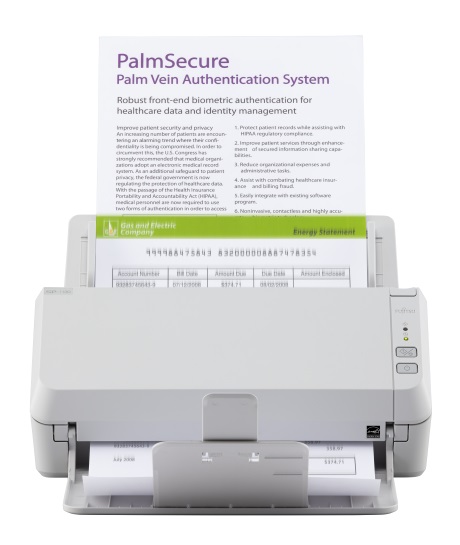
Your needs, this model
Does it fit your priorities?
How does the SP-1130 differ from SP-1120 if their ADF capacities are equal?
PFU lists 50 sheets for each. The SP-1130 is rated 30 ppm/60 ipm versus the SP-1120 at 20 ppm/40 ipm, while both have the USB-only non-N interface; compare host software, unit state and exact model marking before choosing between used examples.
Explore this need in the finder →Will this model pass a 60-sheet ADF minimum?
No. Its documented 50-sheet capacity applies to A4 80 g/m² or Letter 20 lb stock, and the manual's loaded-stack limit is 5 mm or less. It meets a 50-sheet minimum only under those conditions; a 60-sheet requirement rejects it.
Explore this need in the finder →Does a faster 30 ppm rating mean the scanner is networked?
No. PFU's comparison distinguishes the older SP-1130 from SP-1130N: the non-N model uses USB 2.0/1.1 and has no Ethernet, while the N suffix adds wired networking. Neither wired model is Wi-Fi, and the speed figure is separate from connection options.
Explore this need in the finder →Review basis: This is a source-led assessment of the earlier SP-1130 without the N suffix. PFU America's U.S. discontinued roster names SP-1130 among models no longer for sale but still eligible for extended service; this is not evidence of current stock or an individual unit's coverage. The Global product page, exact-model datasheet and shared SP-1120/SP-1130 manual supply the technical specifications. No U.S. part number, reseller condition, present offer or exact package has been confirmed.
The faster of two 50-sheet USB feeders
PFU specifies the SP-1130 at 30 pages per minute simplex and 60 images per minute duplex for A4 portrait paper at 200/300 dpi. It is an automatic duplex ADF, so both sides can be captured in the feeder workflow instead of requiring a separate pass. The published rating is not a field test or a prediction of end-to-end office productivity: preparing stacks, checking mixed originals, transferring images, running OCR and saving files all add time. PFU's separate expected daily volume is 4,500 sheets, which the manufacturer identifies as a use-volume calculation—not a durability guarantee or observed output.
The feeder capacity is 50 sheets at A4 80 g/m² or Letter 20 lb. The shared operator guide also gives a loaded-stack limit of 5 mm or less. These conditions mean “50-sheet ADF” is a qualified capacity, not permission to load any 50 pages. Heavier stock, worn originals and mixed materials should be checked against the manual's load instructions; the scanner may need a smaller stack. It passes a 50-sheet minimum under its published basis but leaves a request for 60 sheets or more.
Model suffix matters more than the headline name
The non-N SP-1130 is distinct from SP-1130N and SP-1130Ne. PFU's comparison says that SP-1130N has wired Ethernet, while the older SP-1130 has USB 2.0/1.1 and no Ethernet. None of those facts establishes Wi-Fi for the no-N model. Inspect the full model label and rear connection panel before considering a listing: a shortened title can hide the feature that determines whether it belongs on a shared network. This review does not transfer the N or Ne suffix's configuration, SKU, software bundle or network route to the SP-1130.
The intended arrangement here is a USB host computer with compatible capture software. PFU lists TWAIN and ISIS; the exact technical material also names TWAIN x64 and WIA. That helps identify possible application interfaces, but it cannot guarantee the current driver runs on a particular computer. Check operating-system support, processor architecture, application version and the download for the exact model and hardware state. An old setup disc or a compatible driver standard alone is not enough to establish a working deployment.
What the scanner handles—and what it lacks
The Global table lists 600-dpi optical resolution, supported sheets up to 8.5 × 14 inches, paper weight from 50 to 209 g/m² and plastic-card thickness up to 0.76 mm. The shared guide's detailed loading instructions should govern the actual mix; card thickness, stock stiffness and overlap-detection behavior can affect feeding. A specification for card support is not a promise that a particular worn used machine will separate every mixed stack cleanly.
There is no flatbed in the reviewed configuration, and no separate Manual Feed/bypass path is established by the exact model sources. Although the page describes supported paper and cards, a general ADF route is not a special-original mode. Physical Scan/Stop and Power buttons simplify a basic desk workflow but do not make a touchscreen control panel. The reviewed source material documents a USB-to-computer setup, not scanning from a phone, direct cloud delivery or network use.
SP-1130 versus SP-1120
For shoppers comparing the two non-N scanners, the important performance distinction is 30/60 versus 20/40 ppm/ipm. Their sourced ADF capacity remains the same 50-sheet basis, so the SP-1130's faster rating does not create a larger batch. Their no-N interface is USB, and PFU's suffix comparison distinguishes both from their wired-network N versions. Choose between individual used examples by prioritizing compatible software, verified unit condition, roller state, return terms and the needed speed class; the 4,500 versus 3,000 daily-volume figures are not evidence that one example has more remaining service life.
Checklist for an earlier-model listing
Confirm the full no-N SP-1130 label, USB port and power supply; ask whether the exact unit has passed a feed test and whether maintenance parts are available; check the host driver before purchase; and verify that any claimed adapter, cable, software or manual is included. The old datasheet's box list is not a promise for a used package. PFU's U.S. extended-service note is roster-level language, not proof that a resale purchaser can transfer coverage. Require clear seller condition and return information, especially if the scanner is intended for a deadline-sensitive workflow.
Bottom line: the SP-1130 may suit a compatible USB workstation that needs a duplex ADF, a 50-sheet qualified load and a higher manufacturer-rated speed than the SP-1120. It is not the networked N model, has no documented Wi-Fi or separate special-feed route, and should not be selected on the assumption that the daily-volume number predicts a used unit's remaining life.
Key specifications
Key details at a glance
| Scanner class | Professional desktop sheet-fed scanner |
|---|---|
| Manufacturer-listed simplex rate | 30 ppm |
| Manufacturer-listed duplex image rate | 60 ipm |
| Automatic document feeder capacity | 50 sheets |
| Optical resolution | 600 dpi |
| Connection options | USB |
| Automatic duplex capture | Yes |
| Touchscreen | No |
| TWAIN driver documented | Yes |
Use the exact model’s instructions for operating limits, supplied equipment and version differences.
Sources for this review
Sources for this assessment
- PFU America U.S. discontinued scanner roster
- PFU/Ricoh Global exact FUJITSU SP-1130 product page
- PFU/Ricoh SP-1130 datasheet, July 2022
- PFU FAQ: SP-11xxN versus SP-11xx model differences
- PFU/Ricoh SP-1120/SP-1130 Operator's Guide
- PFU current SP-11xx family host and application support FAQ
- PFU/Ricoh Global exact SP-1130 page-linked product photograph

Compare the workflow before you choose
Use the finder to test your connection, paper and software requirements against the documented scanner arrangements.