
Your needs, this model
Does it fit your priorities?
Does the fi-8290 FADGI bundle guarantee that our scanned records meet FADGI?
No. PFU says the bundle can fulfill FADGI MTR requirements when calibrated accordingly and operated at rated speeds. Your team still has to decide whether MTR applies, set the capture and acceptance process, evaluate images and metadata, manage originals, and maintain verification. The bundle is not a certification of a particular project.
Explore this need in the finder →What is the practical difference between the fi-8290 and fi-8190 FADGI bundles?
Their documented chassis both have a 100-sheet duplex ADF, USB/Ethernet and a separate manual-feed mode. The fi-8290 adds a letter-size flatbed; the fi-8190 does not have one. That distinction can matter for bound or fragile originals, but it does not make every archival item safe to scan or change the FADGI process. Compare the exact original types and review the operator guide.
Explore this need in the finder →Does the package include GoldenThread analysis software?
PFU's current page says GoldenThread software is separate. Its 2024 fi-8290 package sheet says GoldenThread NXT was to be installed before the service technician arrived, but that is dated guidance; confirm who supplies and licenses the current version and whether that prerequisite still applies.
Explore this need in the finder →Can the manual-feed mode replace the flatbed for every unusual original?
No. The operator guide treats manual feed as a separate ADF mode for supported originals such as booklets or envelopes; it slows scanning and disables overlap detection for folded or multilayered media. Use the model's weight, thickness, size, loading and carrier-sheet directions. The flatbed is a separate letter-size capture surface, not a universal promise for fragile or oversized material.
Explore this need in the finder →The fi-8290 FADGI configuration is not just a name for the ordinary scanner: PFU America lists a separate bundle and its linked 2024 datasheet identifies U.S. part CG01000-310280. The bundle matters only if both the fi-8290's hardware and a carefully defined records workflow fit. This assessment uses manufacturer documentation; no hands-on test or project certification is claimed.
What the FADGI bundle adds
PFU's current U.S. collection describes a package layer of onsite installation, calibration and verification support, operator training, a GoldenThread Device Level Target, and one year of ScanCare Onsite Service. It says the GoldenThread analysis software is sold separately. Those are manufacturer-described services, not evidence that a particular buyer's images, metadata, record set or digitization program will meet its requirements.
The 2024-12-11 fi-8290 bundle sheet establishes part CG01000-310280, but its short package summary and older service narrative do not use exactly the current page's wording. The dated sheet also calls out installation of GoldenThread NXT before a technician visit; that is not a current software or scheduling contract. Ask for a present written quote against the exact part and have it spell out calibration, verification deliverables, training, onsite territory, term, response, renewals and software prerequisites. PFU's current “Shop now” destination goes to the regular fi-8290 scanner page, where an empty cart and demo request are shown—not to a package-specific checkout. No current quote, stock or price is established here.
The meaningful equipment difference: a built-in flatbed
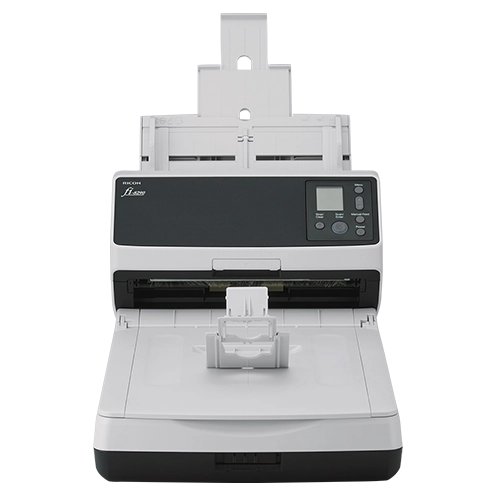
The bundle uses the standard fi-8290 chassis: a duplex automatic document feeder paired with a letter-size flatbed. PFU lists a 100-sheet ADF, USB and wired Ethernet connections, TWAIN-family drivers and 600-dpi optical resolution. The published speed is up to 90 pages per minute simplex or 180 images per minute duplex at specified settings, not a promise for a complete capture workflow or a measured result.
That flatbed is the real hardware distinction from the fi-8190 FADGI package. The two share a 100-sheet feeder and similar duplex ratings, but the fi-8190 does not have a flatbed. The fi-8290's flatbed can provide a separate route for letter-size originals that should not be sent through a stack feeder; it does not imply suitability for every fragile item, oversized document or bound volume. Compare the fi-8190 FADGI package assessment if the flatbed is not essential and you want to understand the related chassis and package limits.
Do not confuse the feeder, flatbed and manual-feed mode
The ADF is for compatible stacks; its 100-sheet figure is tied to specified 20 lb Letter or 80 g/m² A4 stock and the manual's loading and total-thickness limits. The flatbed is a separate, letter-size capture surface. Manual feed is another separate mode through the ADF for supported originals such as certain booklets and multilayered sheets. PFU's shared fi-8000 guide says manual-feed scanning slows down and overlap detection is disabled for folded or multilayered originals because they are expected to have multiple layers. Media weight, thickness, size, loading and carrier-sheet directions still govern.
For a mixed records project, those distinctions affect handling plans more than a headline speed. Decide which originals can go through the feeder, which need the flatbed or a carrier, and which require a different conservation or imaging approach. If the job requires a separate Wi-Fi, mobile-device or computer-free cloud path, the bundle does not add one: the fi-8290 is documented with USB and wired Ethernet computer/network routes. Its LCD uses physical panel buttons rather than a documented touchscreen.
FADGI capability is one part of the records process
PFU conditions FADGI Modern Textual Records performance on appropriate calibration and rated-speed operation. Your records lead still needs to establish whether MTR applies to the material and destination, define image settings and acceptance checks, manage metadata and originals, and plan ongoing verification. Photographs, maps, fragile material and bound collections may require other specifications or handling paths. A calibration service, target or scanner label cannot substitute for that work.
Likewise, “GoldenThread Device Level Target” is not the same thing as included analysis software: PFU says GoldenThread NXT is sold separately. The dated bundle sheet's setup prerequisite should be checked against the current quote. Ask who licenses and installs the software, what report or verification evidence the service provides, and who owns checks after installation or a change in settings.
Before a team shortlists this package
Confirm that CG01000-310280—not simply a standard fi-8290—is on the current written offer. Compare the promised service layer, location, coverage period and renewal cost with the organization's procurement and records requirements. Verify supported operating system, capture software and driver version for the actual unit. PFU warns that fi-8290 scanners manufactured on or after April 1, 2026 use updated identification that PaperStream IP 3.36.0 and earlier will not recognize; it recommends 3.40.1 or later. The manufacture date of any specific scanner is unknown until a seller identifies it.
The fi-8290 FADGI bundle is a specialist configuration to assess when its integrated flatbed, ADF and documented wired capture routes suit the originals, and PFU's described installation and calibration support addresses a defined MTR workflow. If you only need an ordinary duplex office scanner, its service layer may be unnecessary. If you need proof that a project will meet a records requirement, the package alone is not that proof. Use the records-workflow guide to frame those questions, then compare this exact package against your host, media, service and verification requirements.
Key specifications
Key details at a glance
| Scanner class | Professional departmental flatbed sheet fed |
|---|---|
| Manufacturer-listed simplex rate | 90 ppm |
| Manufacturer-listed duplex image rate | 180 ipm |
| Automatic document feeder capacity | 100 sheets |
| Optical resolution | 600 dpi |
| Connection options | USB / Ethernet |
| Automatic duplex capture | Yes |
| Separate manual-feed route | Yes |
| Touchscreen | No |
| TWAIN driver documented | Yes |
Use the exact model’s instructions for operating limits, supplied equipment and version differences.
Sources for this review
Sources for this assessment
- PFU America: current U.S. FADGI-capable fi Series bundle collection
- PFU America: fi-8290 FADGI bundle datasheet (2024-12-11)
- PFU America: fi-8290 U.S. product page and FADGI Shop now destination
- PFU America: fi-8290 U.S. scanner datasheet
- PFU America: fi-8000 Series Operator's Guide (fi-8290 included)
- PFU America: PaperStream IP scanner identification update notice
Compare the workflow before you choose
Use the finder to test your connection, paper and software requirements against the documented scanner arrangements.