
Your needs, this model
Does it fit your priorities?
Does the fi-8820 FADGI package give the scanner a larger feeder than the standard fi-8820?
No. The 500-sheet ADF belongs to the fi-8820 chassis in both assessments. The FADGI package changes the documented service and calibration layer, not the feeder capacity; PFU's card gives its stated capacity for the scanner family separately from the bundle services.
Explore this need in the finder →What should a team verify about the FADGI bundle's services?
Request a current written quote against part CG01000-310225. PFU's current page lists calibration and verification support, training, a target and one year of onsite ScanCare, while its linked 2024 sheet summarizes Installation, Training & Onsite Service. Do not assume those different wordings are interchangeable or infer present price or stock.
Explore this need in the finder →Does its bundle mean GoldenThread NXT is included or that every scan is FADGI compliant?
Neither. PFU says GoldenThread NXT analysis software is sold separately and that the bundle can fulfill FADGI MTR requirements when calibrated accordingly and operated at rated speeds. A team still has to choose and maintain the applicable workflow, software, verification and records controls.
Explore this need in the finder →The Ricoh fi-8820 FADGI bundle combines PFU’s 500-sheet fi-8820 production scanner with a model-specific service package. The current U.S. FADGI collection lists onsite installation, calibration and verification support, operator training, a GoldenThread Device Level Target and one year of ScanCare Onsite; its linked 2024 datasheet identifies bundle part CG01000-310225. This is not a faster or larger-feeder fi-8820: the service package is the distinction. The current card’s “Shop now” path opens the underlying fi-8820 scanner page, not a bundle checkout, so no current quote or package-specific online offer is established here.
What is actually different from the standard fi-8820?
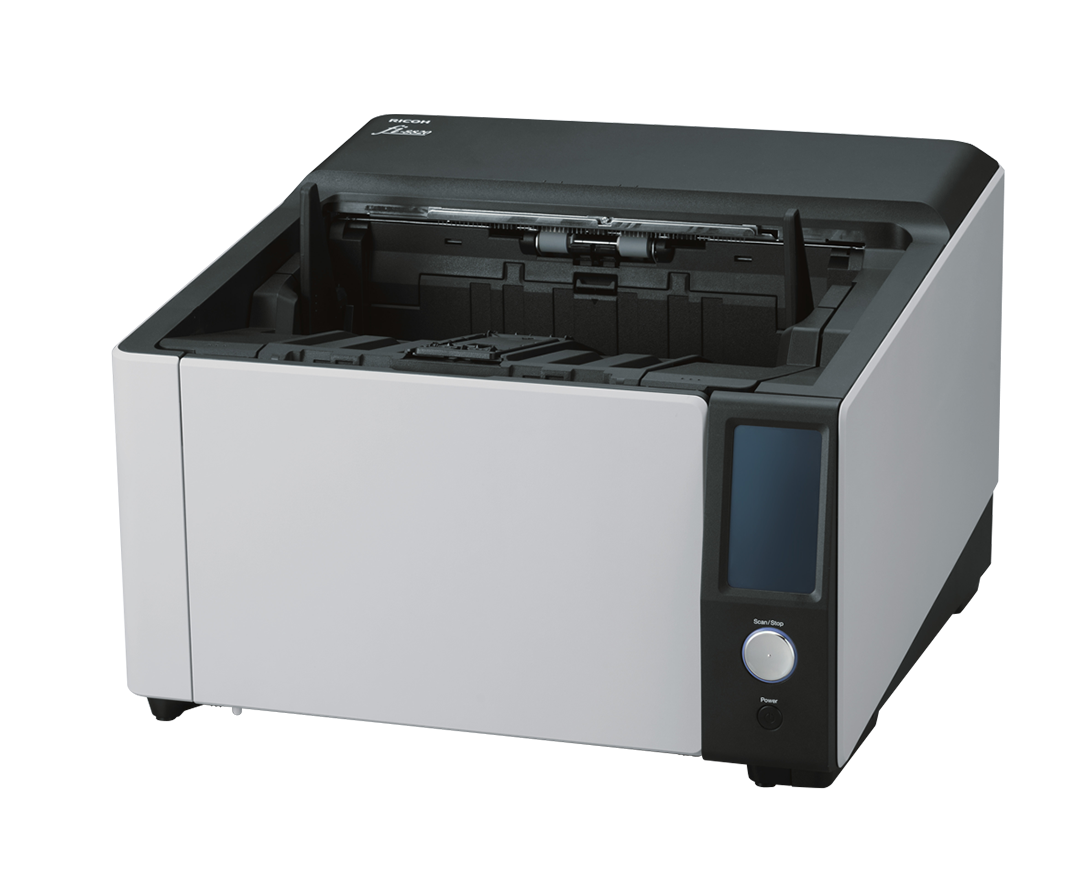
The scanner chassis remains the wired fi-8820, with its duplex 500-sheet ADF, 4.3-inch touchscreen, USB and Ethernet, and manufacturer-rated landscape maximum up to 120 ppm/240 ipm. Those specifications belong to the scanner, not to the bundle’s service layer. PFU’s current FADGI page describes installation, calibration and verification support, training, a device-level target and one year of onsite ScanCare. Its FAQ says GoldenThread NXT analysis software is sold separately. The dated 2024 package sheet instead abbreviates the inclusion as “Installation, Training & Onsite Service” and provides additional one-year service language. Because the documents do not use identical terms, a purchasing team should obtain a current written scope against CG01000-310225 rather than assume the package wording has not changed.
FADGI support is not a compliance certificate
PFU says its fi-series scanners can fulfill FADGI Modern Textual Records requirements when calibrated accordingly and operated at rated speeds. Its own description makes clear that calibration, verification, software, operating procedures and ongoing maintenance contribute to a capable process. The included target can support a verification routine, but the separately sold GoldenThread NXT software analyzes target images; verify who licenses and installs it, what evidence the service visit supplies and how often the organization must repeat verification.
“FADGI” also does not mean the same profile is suitable for every collection. The MTR category concerns well-defined printed documents on modern office paper. A scanner package cannot decide a records program’s image targets, metadata, file naming, preservation storage or acceptance criteria. Photographs, bound items, fragile originals, maps and mixed collections may require different handling or technical targets. Before selecting a bundle, the responsible archivist or records owner should document the materials, desired output, verification method and process ownership. For broader guidance, see the FADGI and records workflow guide.
Where the fi-8820 fits among the production trio
The fi-8820’s 500-sheet feeder and up-to-120/240 landscape rating are lower than the fi-8930 and fi-8950, each of which PFU lists with a 750-sheet feeder and higher rated landscape speeds. That difference can affect reload frequency and rated scan time, although it says nothing by itself about the end-to-end time for preparation, exception handling, OCR, review and delivery. The fi-8820 can make sense if the organization wants a current fi-8900-series chassis but does not need the siblings’ higher stated feeder capacity or speed. Compare the standard fi-8820 hardware assessment for scanner-only tradeoffs; it does not include the FADGI service package.
Feed paths and computer setup
The scanner supports duplex ADF capture and separate U-turn and straight-through/manual routes. The operator guide distinguishes manual continuous feeding from one-at-a-time handling: its 1.25 mm straight-path figure applies to supported thick envelopes or thin booklets, not every document. Route choice changes ejection, handling and speed, and the guide’s permitted paper sizes, weights and thicknesses should govern special originals. This is still a sheet-fed machine, not a flatbed for books or bound pages.
USB and wired Ethernet support computer-based capture; the documented driver set includes TWAIN, TWAIN x64, ISIS and WIA. The product page’s touchscreen is an operator interface, not proof of wireless, phone or computer-free cloud operation. Check host operating-system and application versions, network setup and driver policy before ordering; PFU notes that its fi-series models do not run on Windows 10 or 11 ARM-based PCs. The scanner is also a substantial 50.7 lb device, so installation access, floor or counter placement, servicing and onsite location belong in the plan.
Questions to settle before a purchase request
Ask the seller to identify part CG01000-310225 on the current quote and state exactly which calibration, verification, training, target, installation and service benefits are included, their term and geographic scope, and what renews afterward. Confirm whether the current one-year ScanCare description applies to this offered part and how it relates to the older datasheet’s wording. Ask who supplies GoldenThread NXT, whether its license and installation are separate, and what proof of calibration and verification the organization receives. Also confirm delivery, power, cable, compatible host, media limits, service response and any optional imprinter or other accessory; no accessory is treated as included without an explicit package list.
This bundle is worth assessing when an organization has a documented MTR-focused process and values a defined service, calibration and training layer around a production scanner. It is a poor shortcut for a team that needs Wi-Fi, direct cloud delivery, a flatbed, a compliance guarantee or an unverified promise of current availability. The assessment is based on manufacturer documentation, not hands-on use or testing. No current price, stock, seller terms or independent performance result is claimed.
Key specifications
Key details at a glance
| Scanner class | Professional production sheet-fed scanner |
|---|---|
| Manufacturer-listed simplex rate | 120 ppm |
| Manufacturer-listed duplex image rate | 240 ipm |
| Automatic document feeder capacity | 500 sheets |
| Optical resolution | 600 dpi |
| Connection options | USB / Ethernet |
| Automatic duplex capture | Yes |
| Separate manual-feed route | Yes |
| Touchscreen | Yes |
| TWAIN driver documented | Yes |
Use the exact model’s instructions for operating limits, supplied equipment and version differences.
Sources for this review
Sources for this assessment
Compare the workflow before you choose
Use the finder to test your connection, paper and software requirements against the documented scanner arrangements.