
Your needs, this model
Does it fit your priorities?
Does a 500-sheet rating mean I can feed any 500-page batch at once?
No. PFU rates the fi-6400 at up to 500 A4/Letter sheets on 80 g/m2 (20 lb) stock, but says capacity varies with paper thickness. Its shared operator guide adds a stack-height and total-weight restriction. Treat 500 as a qualified per-load rating, not an unattended run, daily throughput or a promise for a mixed stack; inspect the exact feed and media rules.
Explore this need in the finder →Can the fi-6400 scan directly from a phone over Wi-Fi?
The reviewed model sources document a USB-connected computer workflow and historical computer drivers, not a Wi-Fi, mobile-device or computer-free cloud route. Selecting Wi-Fi with earlier models included therefore excludes this model; that is a statement about this evidence and workflow, not a claim that no other scanner can do it.
Explore this need in the finder →What should I confirm before using one with a modern capture workstation?
The fi-6400 has documented historical TWAIN/ISIS drivers, but the current PFU PaperStream IP supported-model table lists fi-6800 and not fi-6400. Do not read the table's omission as proof no legacy package exists: confirm the exact obtainable driver, computer OS and architecture, USB cable, capture application and working unit before relying on a match.
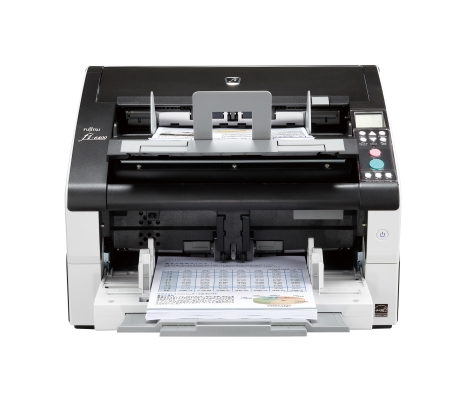
Explore this need in the finder →The Fujitsu fi-6400 is an earlier production scanner for staffed, high-volume document rooms—not a compact home-office feeder. Its appeal is a wide A3-capable duplex path, a large hopper and a documented way to feed one unusual sheet at a time. Its drawback is equally practical: this is a discontinued, 70.5-pound machine whose used-unit condition and computer setup matter as much as its published speed. This assessment uses manufacturer material; it is not a hands-on test or a claim about any current seller.
What the speed figures do—and do not—tell you
PFU lists up to 100 pages per minute and 200 images per minute for landscape A4/Letter color scanning at 200 or 300 dpi. Portrait documents are rated lower at 85 ppm and 170 ipm. Those are manufacturer rates, not observed production output: the published note itself says transfer and software processing affect actual speed. If your job has extensive image cleanup, barcode work, indexing or operator checks, the hardware number is only one part of the schedule.
The scanner accepts A3 and double-letter originals through the ADF and long sheets up to 120 inches, but that long-paper figure comes with a resolution limit: material longer than 17 inches is capped at 400 dpi through 34 inches, and longer sheets through 120 inches at 300 dpi. Paper weights also vary by document size. Check the exact guide for the real source stock rather than assuming one published maximum applies to every original.
A large hopper with important qualifications
The fi-6400’s 500-sheet figure is a per-load rating for A4/Letter paper at 80 g/m² (20 lb), not an all-stock promise. PFU says loading varies with paper thickness; its shared operating guide further qualifies the 500-sheet procedure by the stack height and total weight. A batch of heavier, mixed, folded or unusually sized originals should be planned around the applicable manual limits. Even a new machine would need paper appropriate to its path; an old feeder also needs a condition check.
The separate Manual Feed mode is useful for an envelope, folded original or other occasional sheet that should not join the automatic stack. But it is not a second input tray: the operator feeds one sheet at a time through the ADF. The guide also warns that Paper Protection is disabled and no paper-separation force is applied in manual-feed mode. That changes the handling risk. Use the correct procedure and do not mistake the mode for a flatbed or a safe bypass for every fragile page.
Host, driver and workflow are the make-or-break questions
The documented connection is USB to a computer; the reviewed model sources do not establish Wi-Fi, phone scanning or a computer-free cloud route. Historical fi-6400 material lists TWAIN and ISIS drivers and PaperStream Capture, so a suitable application path existed. That does not answer whether a compatible driver package is still obtainable for a particular workstation. The current PFU PaperStream IP table lists the fi-6800 among supported discontinued models but does not list the fi-6400. That omission is not proof that no legacy software exists, but it is a reason to verify the exact driver version, operating system, processor architecture, USB interface and capture application before buying.
PFU describes three ultrasonic multifeed sensors and an Intelligent MultiFeed function that can ignore false alerts from attached photos or notes. These features help a planned batch; they cannot certify that a used roller set will feed well or protect every original. Confirm the scan path, image output and error recovery with the specific unit and the documents you intend to process.
Two public workload figures should stay separate
There is a real source mismatch around daily volume. The Fujitsu U.S. brochure labels 30,000 pages as a Daily Duty Cycle, while the exact-model Global specification table calls 91,000 sheets an Expected Daily Volume. Those labels and values are not interchangeable. I do not collapse them into one recommendation or use either as a guaranteed daily workload. The 500-sheet hopper and 100-ppm landscape rate are useful comparisons, but neither proves how many mixed pages a real team can safely complete in a shift.
PFU lists the fi-6400 in its U.S. section for discontinued scanners: it is no longer available for sale, though the roster describes extended-service eligibility. That status does not prove a used buyer can transfer coverage. The brochure’s 18.1-by-16.9-by-12.2-inch body dimensions exclude the hopper, and the scanner weighs 70.5 pounds. Make a plan for a stable support surface, lifting, paper access and output clearance. Roller intervals in the manual are maintenance references, not evidence of remaining life or parts stock.
Who should consider it
The fi-6400 is a conditional fit for a staffed records or production team that regularly feeds A3/Letter duplex batches, has a known USB workstation and can confirm the driver path. It may be excessive for occasional household paperwork, and the current evidence does not support a wireless or mobile workflow. The faster fi-6800 is a separate model with a higher landscape rating and an additional Ultra Wide SCSI interface; do not confuse the two when matching an old chassis to a host.
Before considering a specific unit, verify the exact fi-6400 model label, included hopper and stacker parts, interface and cable, roller and glass condition, counter or service history, obtainable driver, host application and return terms. Ask the seller to demonstrate the exact paper sizes and stock you need. The U.S. roster and old brochures are product evidence, not proof of today’s scanner stock, price, package, operating condition or transferable support. No seller listing, ASIN or current offer is established by this review.
Key specifications
Key details at a glance
| Scanner class | Professional production sheet-fed scanner |
|---|---|
| Manufacturer-listed simplex rate | 100 ppm |
| Manufacturer-listed duplex image rate | 200 ipm |
| Automatic document feeder capacity | 500 sheets |
| Optical resolution | 600 dpi |
| Connection options | USB |
| Automatic duplex capture | Yes |
| Separate manual-feed route | Yes |
| TWAIN driver documented | Yes |
Use the exact model’s instructions for operating limits, supplied equipment and version differences.
Sources for this review
Sources for this assessment
- PFU America U.S. discontinued-scanner roster
- PFU/Ricoh Global archived fi-6400 exact-model specifications
- PFU/Ricoh fi-6400 product catalog PDF
- Fujitsu U.S. fi-6400 product brochure (PDF-reader observation)
- PFU/Ricoh fi-6400/fi-6800 Operator's Guide
- PFU/Ricoh PaperStream IP current supported-model and OS table
- PFU/Ricoh official exact fi-6400 page-linked product image

Compare the workflow before you choose
Use the finder to test your connection, paper and software requirements against the documented scanner arrangements.