
Your needs, this model
Does it fit your priorities?
Can the fi-7140 serve a USB computer workflow that requires two-sided capture and TWAIN?
The U.S. model page lists USB and TWAIN/ISIS, and the exact-model Global table lists USB 2.0/1.1 and TWAIN/TWAIN x64/ISIS. The sources support a generic USB-to-computer path, but disagree about the USB generation; check the exact unit, port and cable, and verify its driver with the host and capture application.
Explore this need in the finder →What does the 80-sheet ADF rating mean for a real batch?
PFU rates the feeder at 80 sheets on A4 80 g/m² or Letter 20 lb stock and says the maximum varies with paper weight. The 40 ppm/80 ipm rate and 6,000-sheet expected daily volume are manufacturer figures, not observed throughput or a durability promise; allow for mixed-stock preparation, image processing and saving.
Explore this need in the finder →Is this a substitute for a glass platen or a dedicated special-original feed mode?
No. The reviewed exact-model references specify an ADF scanner, but no flatbed or separate Manual Feed mode. They mention plastic-card capability in the ADF; that does not establish a book, fragile-original or mixed special-media route. Choose a model with an explicitly documented flatbed or special-feed feature when one is essential.
Explore this need in the finder →Review basis: This is a source-led assessment of the exact U.S. fi-7140 model, not a hands-on test. PFU America lists it in the discontinued Workgroup roster as no longer for sale but eligible for extended service. The sources do not establish a U.S. part number, current offer, seller condition or package contents, so this review evaluates the scanner model rather than a particular used or refurbished unit.
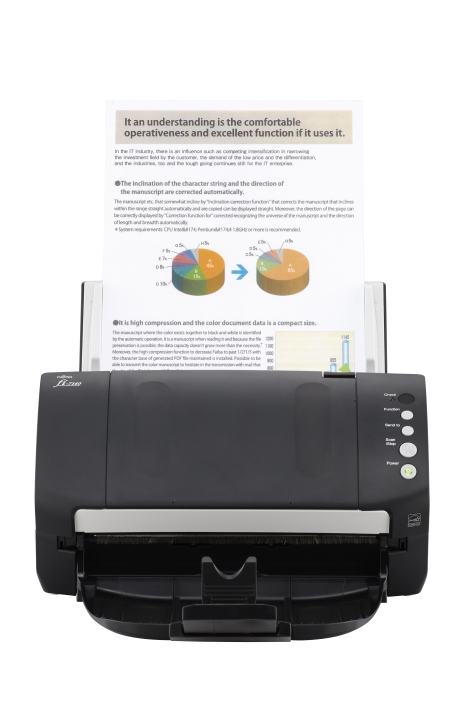
A compact duplex feeder for one USB workstation
The fi-7140 is a sheet-fed office scanner with automatic two-sided capture. Its exact-model Global specification rates the ADF at up to 40 pages per minute or 80 images per minute for A4 portrait originals at 200/300 dpi. Those are manufacturer figures: they do not include the full time spent sorting a stack, transferring data, cleaning images, applying OCR and saving files. The rate may help compare this model with another scanner, but it is not a promise that an ordinary batch will finish in a set number of minutes.
PFU specifies an 80-sheet ADF when loaded with A4 80 g/m² or Letter 20 lb paper. The same table warns that maximum capacity depends on paper weight and can vary. A heavy stack, mixed originals or worn paper may call for a smaller load and more attention than the headline number suggests. PFU also lists an expected daily volume of 6,000 sheets, calculated from typical scanner-use hours and its speed rating; that is not an independent endurance test or a guarantee of daily output.
Know what this model does not add
The inspected model-specific references describe an ADF and card handling, not a glass platen. They do not establish a separate Manual Feed mode either. A plastic card accepted in the feeder is not a replacement for a flatbed when the original is bound, fragile, larger than the supported ADF route or awkward to feed. If such originals are routine, compare a combo model such as the fi-7240 or fi-7260, whose exact-model references document a flatbed as well as an ADF.
The fi-7140 is a wired computer capture device in the reviewed record. PFU's U.S. model page describes USB and integrated TWAIN/ISIS connectivity. Its exact Global technical table lists USB 2.0/1.1 and PaperStream IP TWAIN/TWAIN x64/ISIS interfaces. The U.S. page, however, labels the model's support as USB 3.2. Since those interface generations do not agree, this assessment treats USB host capture—not a particular USB revision—as established. Check the connector, cable and host requirement on the exact machine before placing it into a fixed workstation image.
Software fit is an early buying question
TWAIN and ISIS matter only if the intended capture application, operating system and driver release support the actual scanner. PFU's PaperStream IP table, current as of October 6, 2026, lists fi-7140 among discontinued models. That is not proof that every old unit still runs on every current desktop, nor a guarantee that a particular driver will remain available. Before choosing an older scanner for a managed office, identify the host OS, application version and driver package first. A model name appearing in a broad support table is a starting point, not the end of compatibility testing.
PFU's U.S. page describes double-sided operation, an 80-sheet feeder and the model's paper-protection features. Its current highlight text discusses sound and image monitoring, while the exact Global model table specifies lag detection. Because the descriptions do not align, this review does not claim that one paper-protection method or one jam-detection behavior applies to every U.S. fi-7140. Treat those features as a prompt to read the precise manual for the specific unit, not a reason to feed irreplaceable originals without supervision.
Where it sits among the four fi-7x60 variants
For a small desk and ordinary document batches, the fi-7140's compact ADF-only body and 40/80 rating may be more relevant than a flatbed or a higher headline rate. The fi-7160 keeps the compact footprint and 80-sheet ADF but moves to a 60/120 rate and an LCD status panel. The fi-7240 adds a separate platen whose Global specification lists an 8.5 × 11.7 inch maximum while retaining the 40/80 ADF rating. The fi-7260 combines a separate platen with the faster 60/120 ADF; its U.S. page calls the flatbed Letter-size, while the Global table lists the same 8.5 × 11.7 inch maximum. These are distinct scanner configurations, not cosmetic editions of one interchangeable package.
PFU says the fi-7140 has been upgraded to the fi-8150. That replacement reference is not evidence that the two are identical, that the fi-8150 has the same connection behavior, or that a seller offers either one. The fi-7140 remains an earlier-model assessment because PFU's U.S. discontinued roster identifies it by name. No current price, stock state or service entitlement for a prospective used unit is established here.
Who should consider it—and what to verify
On documented features, the fi-7140 may suit someone who already has a USB computer workflow, needs duplex capture, wants an 80-sheet nominal load and can verify a compatible TWAIN/ISIS path. It is not a strong match when Wi-Fi, scanning from a phone, computer-free cloud delivery, a touchscreen, a flatbed or a separate manual-feed route is essential. The absence of those routes in this assessment is not a claim that another product in the wider market lacks them.
Before buying, confirm the exact fi-7140 marking, unit condition, host-driver compatibility, the connector and supplied cable, feeder wear, roller availability, the paper limits and seller return terms. Ask separately about power supply and included accessories; no exact U.S. package was verified. The ratings can frame a comparison, but the unit's software path and physical state will determine whether this earlier scanner is practical for your actual documents.
Key specifications
Key details at a glance
| Scanner class | Professional desktop sheet-fed scanner |
|---|---|
| Manufacturer-listed simplex rate | 40 ppm |
| Manufacturer-listed duplex image rate | 80 ipm |
| Automatic document feeder capacity | 80 sheets |
| Optical resolution | 600 dpi |
| Connection options | USB |
| Automatic duplex capture | Yes |
| TWAIN driver documented | Yes |
Use the exact model’s instructions for operating limits, supplied equipment and version differences.
Sources for this review
Sources for this assessment
- PFU America: exact U.S. fi-7140 model and driver page
- PFU America: U.S. discontinued scanner and service-status roster
- PFU/Ricoh Global: exact-model fi-7140 page
- PFU/Ricoh Global: exact-model fi-7140 datasheet
- PFU/Ricoh Global: PaperStream IP scanner table, current as of October 6, 2026
- PFU/Ricoh Global: exact-model fi-7140 official product image

Compare the workflow before you choose
Use the finder to test your connection, paper and software requirements against the documented scanner arrangements.