
Your needs, this model
Does it fit your priorities?
Does the fi-4990C's 1,000-sheet figure mean any paper can be loaded in a full A3 stack?
No. PFU states the 1,000-sheet maximum at 64 g/m², and its exact driver guide qualifies hopper capacity to A4 high-quality paper at a stated ream weight and normal environment. The U.S. sheet lists selectable 250- and 500-sheet positions, but the English evidence reviewed does not provide an A3-by-paper-weight capacity chart. Check the exact manual and intended stock; this is not a universal or daily-volume guarantee.
Explore this need in the finder →Can the fi-4990C connect to an ordinary USB-only computer because it has TWAIN?
No USB route is documented. The exact sources specify Ultra Wide SCSI and a third-party expansion slot, and list TWAIN/ISIS only as historic software. Verify the actual SCSI controller, cable, driver and named application on the intended computer before relying on this model.
Explore this need in the finder →Does the exact model have duplex color and a separate flatbed?
The fi-4990C is documented as a color, duplex ADF with up-to-A3-class originals; a flatbed route is not documented for this model. Do not transfer the platen of the separate fi-4750C or another fi-series scanner. ADF load capacity and flatbed capacity are separate questions.
Explore this need in the finder →Is Manual Feed documented, and can that label be treated as a safe bypass for cards or fragile originals?
PFU's exact archived product page lists an ADF and Manual Feed. The English profile available for review does not define the manual-mode path or its media limits, so do not assume a separate bypass, one-at-a-time method, card support or permission to feed fragile stock; obtain the model guide for the exact operation.
Explore this need in the finder →Does a historical TWAIN listing establish that a current Windows computer will run it?
No. The historical U.S. sheet identifies TWAIN/ISIS support for Windows 98, 2000, Me and XP; the archived Global page displays older operating-system symbols. Neither shows that a modern OS, SCSI adapter, driver installer, application or seller's included software works today.
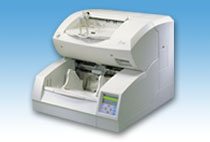
Explore this need in the finder →The Fujitsu fi-4990C is an earlier production scanner for a narrow kind of work: large, repeated duplex batches where the operator already has a compatible legacy SCSI capture system. Its documents describe a color CCD, an ADF rated up to 1,000 sheets on stated paper conditions, A3-class originals and a manual-feed mode. They do not establish that a machine offered today has a working card, cable, driver, clean rollers or complete package. This is a documentary assessment, not a hands-on test.
What the 1,000-sheet figure does—and does not—mean
The U.S. historical datasheet identifies a 1,000-sheet ADF and selectable 250- and 500-sheet positions. PFU's exact archived profile gives the maximum at 64 g/m² (17 lb); its driver reference guide separately describes the 1,000-sheet hopper on A4 high-quality paper at a 55 kg ream basis in normal temperature and humidity. Those qualifications matter. The reviewed English material does not provide a size-by-size chart that guarantees 1,000 A3 sheets or an equivalent load for every stock. Treat the number as a published maximum for a stated basis, not an everyday batch promise or daily duty rating.
PFU lists ADF duplex and a separate Manual Feed designation. The English model sources available here do not spell out the manual procedure, whether it uses the same hopper, or which unusual originals it permits. Do not assume it is a bypass tray for cards, envelopes, folded sheets or fragile paper. Obtain the exact operating instructions for the unit and the stock you intend to feed. The 297 × 878 mm long-page mode in the driver guide is expressly black-and-white only; it is not an A3 color mode.
Color, duplex speed and image handling
The exact model profile specifies a color CCD and 400 dpi optical resolution, with binary, grayscale and color output. It lists color at 85 pages per minute / 170 image sides per minute at 150 dpi in A4 portrait, and binary at 90 ppm / 180 ipm at 200 dpi. The historical U.S. sheet separately lists 90/180 for color at 200 dpi on Letter portrait and footnotes a Pentium III 1 GHz computer with 512 MB RAM or higher for optimum color throughput. These are manufacturer figures under different stated conditions, not a single cross-mode guarantee. PFU's guide cautions that its scanner-only speed can differ from actual reading speed with system configuration. No independent timing is claimed here.
PFU also describes standard color dropout, double-feed detection and image processing such as automatic cropping, deskew, rotation and background/text adjustment. That can make the model relevant to forms capture, but the presence of a feature on an old profile is not proof that a particular used unit's lamps, sensors, rollers, settings or software are working. Image quality and paper reliability need a real, representative acceptance test.
The host is the hard part
The documented host interface is Ultra Wide SCSI, with a third-party expansion slot. The U.S. datasheet's historic TWAIN/ISIS support is for Windows 98, 2000, Me and XP; it does not show that a current Windows or macOS host, modern SCSI adapter, cable, application or driver installer will work. Do not interpret TWAIN as a physical USB connection, and do not count the expansion slot as a network card. Ask the seller to identify the exact installed board and cable, then demonstrate a complete color duplex scan in the intended software on the intended computer. If no known-good legacy capture path exists, this model is a poor fit despite its headline feeder rating.
The fi-4990C is distinct from the earlier fi-4750C, which has a separate flatbed but a much smaller published ADF maximum; neither model's SCSI path should be treated as a modern connection. It is also not the monochrome M4099D. Compare each model's own paper path, software history and interface rather than transferring a sibling's feature list.
Size, lifecycle and what to verify
This is a 65 kg / 143 lb machine, about 588 × 689 × 540 mm before working clearance. The U.S. sheet lists up to 250 VA. Plan for a stable, suitable surface, floor access, ventilation, tray space, safe lifting and freight; these figures are not crate dimensions. The option endorser/inprinter is not standard by default. The exact U.S. datasheet calls CG01000-491901 a part number, but that historical reference is not a current retail SKU or evidence of the parts included in a second-hand carton.
PFU America places fi-4990C in its Production / Discontinued for Service roster, meaning the model is no longer eligible for extended service coverage through that program. This is lifecycle context, not a statement about the condition, return rights or availability of any offered unit. Before considering one, confirm the exact fi-4990C nameplate, SCSI controller and cable, working duplex color feed, the actual hopper settings and stock limits, the manual-feed instructions, consumables, software media, missing covers or trays, maintenance history, service options, return terms and safe shipping. No current host compatibility, seller package, Amazon listing identity, price or live stock was established. The controlling sources are PFU's archived exact-model profile, its historical U.S. datasheet, the model-specific driver reference table and PFU America's U.S. lifecycle roster.
Key specifications
Key details at a glance
| Scanner class | Professional production adf |
|---|---|
| Manufacturer-listed simplex rate | 90 ppm |
| Manufacturer-listed duplex image rate | 180 ipm |
| Automatic document feeder capacity | 1000 sheets |
| Optical resolution | 400 dpi |
| Connection options | Ultra Wide SCSI |
| Automatic duplex capture | Yes |
| Separate manual-feed route | Yes |
| TWAIN driver documented | Yes |
Use the exact model’s instructions for operating limits, supplied equipment and version differences.
Sources for this review
Sources for this assessment

Compare the workflow before you choose
Use the finder to test your connection, paper and software requirements against the documented scanner arrangements.